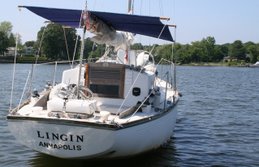
Competitors: 247, 244, 550, 158, 484
Crew: Mark, Brian, Tim
With a few crew known to be out for this race, I was delighted to hear from Xa that he would be able to joon us. It was a good steady 12 kt breeze out of the SE,, and the weather was beautiful.
Unfortunately traffic kept Xa from making the race and he apparently arrived just as we were starting. We were bummed.
We started in the middle of the line, which since we didn't have time to siight the line, made it difficult to be right on the line. Towney and TC started above us at the boat end, and I thought we'd have them, since we could lay the mark from our spot. (We had course B, which is take a left at the spider, head toward Hacketts, round a mark to starboard, then round the usual mark to atarboard.)
What I failed to recognize was:
1. there was a line of boats (some of which faster than us) to windward, which would blanket us, and
2. TC and Towney would have a bit more speed as they bore off for the mark.
So, TC rolled us by the time we got to the spider. We had Towney by about one boat length, and there was a Cal to windward right in front of Towney.
We made an interesting mistake at this point. We kept a bit below Towney and the Cal (L'Orange, of course) but on the rhumb line. We had good speed and were able to keep them in check. However, at the mark, we had to give L'Orange room. When we did that Towney was right behind him, and was able to cut inside of us.
To make matters worse, there was a parade of boats behind him that as they came arouned were all on starboard. We were completely tracpped and actually had to sail to the layline. Before we could really tack.
Of course we had other mishaps. We forgot about the snatch block when we rounded the markl. There were spinnaker setup snafus that made it tough for us to tack.
After rounding the next mark in 3rd after 247 and 550, we got the chute up and followed everyone in. Brian did a great job of spinnaker considering it was probably his 3rd time ever doing it. It made me rerealize that we should really consider using WNR races for switching tasks around and cross training..
I had a blast!
--Tim
Thursday, June 15, 2006


Race to Miles River
Competitors: 550, 247, 501, 244, 484, 57, 562, 505
Crew: Scott, Glen, Brian, Tim
The Miles River Race is one of my favorites. In the Williams family, we've started what I think will be a long standing tradition. I race down with the crew, our families meet us in St. Michaels and we have a nice dinner. (Well truth be told, we're still looking for a good meal in St. Mike's; we're really open to any good recommendations.) Then my family and I spend the night on the boat and sail (or motor if we run out of wind) back the next day.
So, for the race...
We had about 10kts out of the north for the start, and we did a pretty good job starting right at the front of the fleet under spinnaker. We thought the current was ebbing, and that turned out to be pretty true. About 1/3 of the way to bloody point, the wind really died down. We dropped to about 2.5 kts. and the half of the fleet that went west and gybed was looking pretty smart. They had a better angle on the wind, and coming back across it became clear that 247 had the lead. 550 was next but while 57 had more or less followed our path, they had made out a little on us.
It was exciting to watch Scott and THE ROCKET catch back up to them and pass them.
The rounding at Bloody Point was tight. 247 decided to drop their chute, which was a bit odd to us since it didn't seem they need to. 550 did the same, and as we were in 3rd we decided to see how we could fare. With 57 right on our rear, I cut close to Bloody Point, just like I would a Wed. Night Race mark. I was in for a surprise, though. Apparently, about 3 feet under water around Bloody Point there are serious rocks. We hit very hard, and bounce a couple times in the lee of the lighthouse until the spinnaker filled again and pulled us off. I've hit ground on the Chesapeake many times. One thing I appreciate all the more about the Bay now is that it has a sandy bottom. We quickly "checked for leaks", but I was pretty confident that between the massive keel that make Albergs the solid vessels they are, and the fact that we hit on the bottom of the keel (which it just filled with iron), we were safe.
With our chute up and Scott bookin' it, we passed both Towney and TC and took the lead again. Watching the line of Albergs behind us closely, we made a B-line toward the next mark. About a quarter way there, we noticed something odd: the rest of the fleet bore off about 30 degrees. Glen was acting as navigator and check, then re-checked his calculations. We had a near mark and a far mark, but since we were to pass the near mark to starboard, we could ignore it an head straight for the far mark due to the wind and the angle we could sail. He was still pretty confident about our course, when I had an epiphany. "Are you sure we pass the next mark to starboard?" I asked. A quick check of the race particulars, and Glen called for the course change. It was too late, though: we rounded in 4th.
We fought hard on the next leg, and we made it back to 2nd. That final leg, was tricky, though. 247, who was in 1st headed straight to the finish, wing-in-wing. We followed them, and really were covering CB who was right behind us. 501 (Larry Morris) and 550 gybed out and went way to the right. We let them go, thinking they were taking a flyer to try to get back in the game.
While we held our own, and even made out on CB a bit, we couldn't catch TC; his lead was too great. But we had great seats for watching Larry and Towney come back in to the line. Sure enough they had made out considerably going right. (Towney later told me that he had guess that the current was a strong flood--he was right.) We were watching this 18 mile race coming down to three boats finishing with in 2 boat lengths of each other.
Who won? You guessed it, Towney by a nose. 18 miles, and Towney was in 1st place for less than 2 minutes. Only it was exactly the right two minutes! At first when asked, he said it was luck. "It happens way too often to be luck," I said. The man is a great sailor.
Although we came in 4th, it was a really great race and I think we all felt good afterward. We held CB behind us and know that if when we are on, we can clearly compete at the head of the pack.
Brian, Glen and Scott all did a great job. We've really got it down now and I look forward to winning some silver this season.
--Tim
p.s. I dove on LinGin this week, and checked out the damage from the rocks. There are indeed some deep gouges (one the size of my hand), on the very bottom of the keel. Thankfully, I have to have her pulled to get her painted this season anyway, so we'll patch her up then.
Crew: Scott, Glen, Brian, Tim
The Miles River Race is one of my favorites. In the Williams family, we've started what I think will be a long standing tradition. I race down with the crew, our families meet us in St. Michaels and we have a nice dinner. (Well truth be told, we're still looking for a good meal in St. Mike's; we're really open to any good recommendations.) Then my family and I spend the night on the boat and sail (or motor if we run out of wind) back the next day.
So, for the race...
We had about 10kts out of the north for the start, and we did a pretty good job starting right at the front of the fleet under spinnaker. We thought the current was ebbing, and that turned out to be pretty true. About 1/3 of the way to bloody point, the wind really died down. We dropped to about 2.5 kts. and the half of the fleet that went west and gybed was looking pretty smart. They had a better angle on the wind, and coming back across it became clear that 247 had the lead. 550 was next but while 57 had more or less followed our path, they had made out a little on us.
It was exciting to watch Scott and THE ROCKET catch back up to them and pass them.
The rounding at Bloody Point was tight. 247 decided to drop their chute, which was a bit odd to us since it didn't seem they need to. 550 did the same, and as we were in 3rd we decided to see how we could fare. With 57 right on our rear, I cut close to Bloody Point, just like I would a Wed. Night Race mark. I was in for a surprise, though. Apparently, about 3 feet under water around Bloody Point there are serious rocks. We hit very hard, and bounce a couple times in the lee of the lighthouse until the spinnaker filled again and pulled us off. I've hit ground on the Chesapeake many times. One thing I appreciate all the more about the Bay now is that it has a sandy bottom. We quickly "checked for leaks", but I was pretty confident that between the massive keel that make Albergs the solid vessels they are, and the fact that we hit on the bottom of the keel (which it just filled with iron), we were safe.
With our chute up and Scott bookin' it, we passed both Towney and TC and took the lead again. Watching the line of Albergs behind us closely, we made a B-line toward the next mark. About a quarter way there, we noticed something odd: the rest of the fleet bore off about 30 degrees. Glen was acting as navigator and check, then re-checked his calculations. We had a near mark and a far mark, but since we were to pass the near mark to starboard, we could ignore it an head straight for the far mark due to the wind and the angle we could sail. He was still pretty confident about our course, when I had an epiphany. "Are you sure we pass the next mark to starboard?" I asked. A quick check of the race particulars, and Glen called for the course change. It was too late, though: we rounded in 4th.
We fought hard on the next leg, and we made it back to 2nd. That final leg, was tricky, though. 247, who was in 1st headed straight to the finish, wing-in-wing. We followed them, and really were covering CB who was right behind us. 501 (Larry Morris) and 550 gybed out and went way to the right. We let them go, thinking they were taking a flyer to try to get back in the game.
While we held our own, and even made out on CB a bit, we couldn't catch TC; his lead was too great. But we had great seats for watching Larry and Towney come back in to the line. Sure enough they had made out considerably going right. (Towney later told me that he had guess that the current was a strong flood--he was right.) We were watching this 18 mile race coming down to three boats finishing with in 2 boat lengths of each other.
Who won? You guessed it, Towney by a nose. 18 miles, and Towney was in 1st place for less than 2 minutes. Only it was exactly the right two minutes! At first when asked, he said it was luck. "It happens way too often to be luck," I said. The man is a great sailor.
Although we came in 4th, it was a really great race and I think we all felt good afterward. We held CB behind us and know that if when we are on, we can clearly compete at the head of the pack.
Brian, Glen and Scott all did a great job. We've really got it down now and I look forward to winning some silver this season.
--Tim
p.s. I dove on LinGin this week, and checked out the damage from the rocks. There are indeed some deep gouges (one the size of my hand), on the very bottom of the keel. Thankfully, I have to have her pulled to get her painted this season anyway, so we'll patch her up then.
| Pos | Sail | Boat | Skipper | Total | Pos | |
| 1 | 550 | Skybird | Townshend, Rolph | 1 | 1.00 | 1 |
| 2 | 247 | Argo | Williams, T.C. | 2 | 2.00 | 2 |
| 3 | 501 | Solstice | Morris, Larry | 3 | 3.00 | 3 |
| 4 | 244 | LinGin | Williams, Tim | 4 | 4.00 | 4 |
| 5 | 57 | Infinity | Currier, CB | 5 | 5.00 | 5 |
| 6 | 562 | Windswept | Helms, Lanny | 6 | 6.00 | 6 |
| 7 | 484 | Second-2-Nun | Gamber, Harry | 7 | 7.00 | 7 |
| 8 | 505 | Gilleleje | Lehman, Mike | 8 | 8.00 | 8 |
Thursday, May 25, 2006
WNR - Series I - Race 6
Competitors: 550, 484, 247, 152 (Andante), 244
Crew: Brian, Nick, Glen, Tim
The wind was quite variable last night. As we watched the start, it didn't look to good: half the Etchell class started--close hauled--at the pin; the other half started--dead downwind with spinnakers up--at the boat. And so the night proceeded.
We were pushed over early by a bit of current and a bit of wind, near the boat end, and after a quick jaunt back over the line, we cleared and popped the chute heading for the first mark. We mixed it up with L'Orange from the Cal 25 class (arrrgh), but caught, then lost Towney by a couple boat lengths to the first mark.
The closer we got to that mark, we realized that the wind had quit at the mark. There were probably 30 boats all jammed in around the mark. Using a little momentum, and small breath of air, we took the advice of, I think it was Nick, or was it Brian? and went well wide of the bunch. It looked insane as 550 kept tight to the mark and we went about 100 yards wide of it. While the wind died, it shifted about 180 degrees. We found a hole in the mess of boats and keeping the spinnaker up, we made it through a hole. When the wind picked back up, Glen was flying the chute and passing J/105s and MORC boats!! Not the norm for an Alberg.
We took a sizeable lead at this point as Towney and the rest were tangled up in the rounding with the dozens of other boats. We jibed, came around the pin and carried the spinnaker all the way past the green can.
Unfortunately the wind completely died while we were in front of SSA. We sat there, within site of the finish, and watch the last 30 minutes of the time limit expire. We were still in first, but no gun was to be had last night.
Great work everyone! Especially Glen with some great spinnaker work. Scott, it was really sad not to have you along for this race.
BTW: I'm very happy with our downwind speed.
And CONGRATULATIONS! As you can see below, we took first for the first WNR Series this year! Great work everyone. It was a blast.
Let's see if we can show similar speed and skill on our way to St. Michael's this weekend.
--Tim
Crew: Brian, Nick, Glen, Tim
The wind was quite variable last night. As we watched the start, it didn't look to good: half the Etchell class started--close hauled--at the pin; the other half started--dead downwind with spinnakers up--at the boat. And so the night proceeded.
We were pushed over early by a bit of current and a bit of wind, near the boat end, and after a quick jaunt back over the line, we cleared and popped the chute heading for the first mark. We mixed it up with L'Orange from the Cal 25 class (arrrgh), but caught, then lost Towney by a couple boat lengths to the first mark.
The closer we got to that mark, we realized that the wind had quit at the mark. There were probably 30 boats all jammed in around the mark. Using a little momentum, and small breath of air, we took the advice of, I think it was Nick, or was it Brian? and went well wide of the bunch. It looked insane as 550 kept tight to the mark and we went about 100 yards wide of it. While the wind died, it shifted about 180 degrees. We found a hole in the mess of boats and keeping the spinnaker up, we made it through a hole. When the wind picked back up, Glen was flying the chute and passing J/105s and MORC boats!! Not the norm for an Alberg.
We took a sizeable lead at this point as Towney and the rest were tangled up in the rounding with the dozens of other boats. We jibed, came around the pin and carried the spinnaker all the way past the green can.
Unfortunately the wind completely died while we were in front of SSA. We sat there, within site of the finish, and watch the last 30 minutes of the time limit expire. We were still in first, but no gun was to be had last night.
Great work everyone! Especially Glen with some great spinnaker work. Scott, it was really sad not to have you along for this race.
BTW: I'm very happy with our downwind speed.
And CONGRATULATIONS! As you can see below, we took first for the first WNR Series this year! Great work everyone. It was a blast.
Let's see if we can show similar speed and skill on our way to St. Michael's this weekend.
--Tim
Division: Alberg 30 (6 boats)
| Pos | Sail | Boat | Skipper | 1 | 2 | 3 | 4 | 5 | Total Points | Pos |
| 1 | 244 | LinGin | Nurco, Virginia | 3/DNC | 1 | [4/OCS] | 2 | 1 | 7.00 | 1 |
| 2 | 247 | Argo | Williams, T.C. | [2] | 2 | 2 | 1 | 2 | 7.00 | 2 |
| 3 | 550 | Skybird | Liddick, Roberta | 3/DNC | 3 | 1 | [4/DNC] | 3 | 10.00 | 3 |
| 4 | 484 | Second-2-Nun | Bluntschli, Ralph | 1 | 4 | 4/DNC | 4/DNC | [5] | 13.00 | 4 |
| 5 | 152 | Andante | Maas, Louis | 3/DNC | [5/DNC] | 4/DNC | 3 | 4 | 14.00 | 5 |
| 6 | 79 | A30 | Binder, Paula | 3/DNC | 5/DNC | 4/DNC | 4/DNC | [6/DNC] | 16.00 | 6 |
WNR - Series I - Race 5
Competitors: 247, 152, 550, 244
Crew: Brian, Scott, Nick, Glen, Tim, Mark
Unfortunately, I'm a week behind in these posts, and I'm frankly a little fuzzy on this one. Sorry! If anyone recalls the details, please feel free to e-mail me them.
As I recall, we had a good start with the wind out of the south. We lead all the way around the course. With good transitions, it was mainly a foot race. Scott did a great job with the spinnaker and we made good time and took the gun. (Although I do remember they use a horn and not the gun. :-( )
Crew: Brian, Scott, Nick, Glen, Tim, Mark
Unfortunately, I'm a week behind in these posts, and I'm frankly a little fuzzy on this one. Sorry! If anyone recalls the details, please feel free to e-mail me them.
As I recall, we had a good start with the wind out of the south. We lead all the way around the course. With good transitions, it was mainly a foot race. Scott did a great job with the spinnaker and we made good time and took the gun. (Although I do remember they use a horn and not the gun. :-( )
Tuesday, May 16, 2006
WNR - Series I - Race 4
Competitors: 247, 152 (Andante), 244
Crew: Brian, Scott, Nick, Glen
We got off on schedule and had good time to cruise behind the line to
watch things. The course was A3, one we hadn't sailed yet, and I'd
broken my own cardinal rule by not having race particulars on board!
Hmm, hope TC will steer us to the mark.
So we started on starboard, in the clear, about 15 seconds late to the
line. The nice 10kt breeze was steady but it took me a full minute to
find the groove and get her comfortable upwind. TC had us by 4 or 5
lengths but we were sailing with him, slightly to leeward.
As it turned out the upwind leg was a hugely skewed, two-tack affair.
Our false tack (we had the spin pole on top of the lazy jib sheet,
d'oh!) might have had TC wondering but didn't gain us anything .
Brian and Nick (Nick is learning the boat quickly!) did a good, clean
job on the tacks.
Our windward mark was the big boats' return leg rounding mark so our
upwind was a long, crowded gaggle of downwind boats. On the long
starboard tack run to the mark, I sailed poorly in the choppy water
and choppy wind and TC pulled away. Andante sailed well but went way
out to the left and lost a lot getting back to the mark.
The rounding was to starboard and could have been stressful had we not
lucked into a nice slot. Even on starboard, sticking our noses into
the swift-moving flood of big boats approaching the same mark on a
deep port-tack reach--so perpendicular to our course--, would have
made me nervous. We rounded and then took our time resetting the
chute and pole to the correct side before popping it and riding down
the hill. Scott did a great job flying and we made some time on the
Cal 25's in front of us.
Approaching the red nun we hoisted the jib nice and early,
transitioned Brian to trimming while Nick and Scott put in a nice
douse and we came up tight toward the harbor. Watching the lemming
herd of Cals pull away ever-so-slightly, pinching to get high of the
beautiful 139ft sailboat from Rhode Island anchored outside the
harbor, we chose to go low. Footing off, and getting lucky with the
wind holding steady, paid and we entered the harbor in front of the
whole group.
The pressure was nicely consistent in the harbor, and with relatively
few boats on moorings, we two-tacked to the line in 2nd a few minutes
behind TC.
Thanks for coming out guys! It's always a pleasure sailing with you.
-Glen
Crew: Brian, Scott, Nick, Glen
We got off on schedule and had good time to cruise behind the line to
watch things. The course was A3, one we hadn't sailed yet, and I'd
broken my own cardinal rule by not having race particulars on board!
Hmm, hope TC will steer us to the mark.
So we started on starboard, in the clear, about 15 seconds late to the
line. The nice 10kt breeze was steady but it took me a full minute to
find the groove and get her comfortable upwind. TC had us by 4 or 5
lengths but we were sailing with him, slightly to leeward.
As it turned out the upwind leg was a hugely skewed, two-tack affair.
Our false tack (we had the spin pole on top of the lazy jib sheet,
d'oh!) might have had TC wondering but didn't gain us anything .
Brian and Nick (Nick is learning the boat quickly!) did a good, clean
job on the tacks.
Our windward mark was the big boats' return leg rounding mark so our
upwind was a long, crowded gaggle of downwind boats. On the long
starboard tack run to the mark, I sailed poorly in the choppy water
and choppy wind and TC pulled away. Andante sailed well but went way
out to the left and lost a lot getting back to the mark.
The rounding was to starboard and could have been stressful had we not
lucked into a nice slot. Even on starboard, sticking our noses into
the swift-moving flood of big boats approaching the same mark on a
deep port-tack reach--so perpendicular to our course--, would have
made me nervous. We rounded and then took our time resetting the
chute and pole to the correct side before popping it and riding down
the hill. Scott did a great job flying and we made some time on the
Cal 25's in front of us.
Approaching the red nun we hoisted the jib nice and early,
transitioned Brian to trimming while Nick and Scott put in a nice
douse and we came up tight toward the harbor. Watching the lemming
herd of Cals pull away ever-so-slightly, pinching to get high of the
beautiful 139ft sailboat from Rhode Island anchored outside the
harbor, we chose to go low. Footing off, and getting lucky with the
wind holding steady, paid and we entered the harbor in front of the
whole group.
The pressure was nicely consistent in the harbor, and with relatively
few boats on moorings, we two-tacked to the line in 2nd a few minutes
behind TC.
Thanks for coming out guys! It's always a pleasure sailing with you.
-Glen
Sunday, May 07, 2006
WNR - Series I - Race 3
Crew: Glen, Brian P., Nick, Scott, Mark, Andréa and Tim
Competitors: 550, 247 (484 is out for repairs after losing an upper shroud in the NOOD.)
A nice breeze and beautiful weather had us all eagar to start this one. The wind was out of the west, so Scott was excited for the spinnaker start.
We came in on the pin end with a bunch of other boats, and found a nice spot. We luffed a bit, then bore down for speed and had a nice start with speed--except for the fact that we were On Course Side (OCS), or "over early". The penalty for OCS is to turn around, and come completely back over the line and then start again. While you're heading back, you have no rights and have to keep out of everyone's way.
We swung around quickly upon hearing our name hailed, and headed back across the line. Luckily there was not much traffic behind us and we had waited to set the spinnaker (we had started on starboard and planned to quickly gybe to port and set), so it was a pretty quick jaunt back to the line. I heard our number hailed again on the radio, and was not sure if they were just calling us as OCS again, or calling us clear. As we were clearly heading back across the line, and I was pretty sure we were across the line, I swung us back around only to hear our number called once again. Again, we were unsure if they were calling us OCS or clear. We asked whether we were clear and they wouldn't answer. We asked for a repeat of the last call and heard, "244 OCS". Now we had the spinnaker up, and were quite a ways from the line. I was still unclear as to our status (were they repeating the last message before we cleared and were not calling boats cleared?) but I felt pretty sure that we had cleared the line. The result posting us as OCS, cleared it up for me though. :-(
Anyway, we raced hard, taking to the north, while 550 and 247 hugged the south shore. The current and the puffs favored our side and we caught up such that we passed 247 before the mark rounding and 550 shortly thereafter (but just by the skin of our teeth).
A Cal25 blanketed us once by pinching, and then as we tried to drive under, blanketed us by heading way too low. It was painful to watch 550 slip away.
Going into the harbor, we again tangled with boats rolling us and 247 slipped by as well as we passed the Chart House. Very painful.
Two lessons learned:
Everyone worked very hard during this race, and the execution was excellent! Good job.
--Tim
Competitors: 550, 247 (484 is out for repairs after losing an upper shroud in the NOOD.)
A nice breeze and beautiful weather had us all eagar to start this one. The wind was out of the west, so Scott was excited for the spinnaker start.
We came in on the pin end with a bunch of other boats, and found a nice spot. We luffed a bit, then bore down for speed and had a nice start with speed--except for the fact that we were On Course Side (OCS), or "over early". The penalty for OCS is to turn around, and come completely back over the line and then start again. While you're heading back, you have no rights and have to keep out of everyone's way.
We swung around quickly upon hearing our name hailed, and headed back across the line. Luckily there was not much traffic behind us and we had waited to set the spinnaker (we had started on starboard and planned to quickly gybe to port and set), so it was a pretty quick jaunt back to the line. I heard our number hailed again on the radio, and was not sure if they were just calling us as OCS again, or calling us clear. As we were clearly heading back across the line, and I was pretty sure we were across the line, I swung us back around only to hear our number called once again. Again, we were unsure if they were calling us OCS or clear. We asked whether we were clear and they wouldn't answer. We asked for a repeat of the last call and heard, "244 OCS". Now we had the spinnaker up, and were quite a ways from the line. I was still unclear as to our status (were they repeating the last message before we cleared and were not calling boats cleared?) but I felt pretty sure that we had cleared the line. The result posting us as OCS, cleared it up for me though. :-(
Anyway, we raced hard, taking to the north, while 550 and 247 hugged the south shore. The current and the puffs favored our side and we caught up such that we passed 247 before the mark rounding and 550 shortly thereafter (but just by the skin of our teeth).
A Cal25 blanketed us once by pinching, and then as we tried to drive under, blanketed us by heading way too low. It was painful to watch 550 slip away.
Going into the harbor, we again tangled with boats rolling us and 247 slipped by as well as we passed the Chart House. Very painful.
Two lessons learned:
- Whoever is calling the line for the start will officially call us clear if we have to turn around for being OCS.
- Whereas the name of the game for the NOOD and Canadian races is the current, the name of the game for WNR is execution, followed closely by keeping clear of other boats (particularly from other classes).
Everyone worked very hard during this race, and the execution was excellent! Good job.
--Tim
Tuesday, May 02, 2006
NOOD Picture
 Here's another shot that Brian took. Probably the only one he got to take during an actual race. Note Towney in the distance. This is a stressful time; we're doing everything we can think of to go as fast as possible.
Monday, May 01, 2006
NOOD Pictures
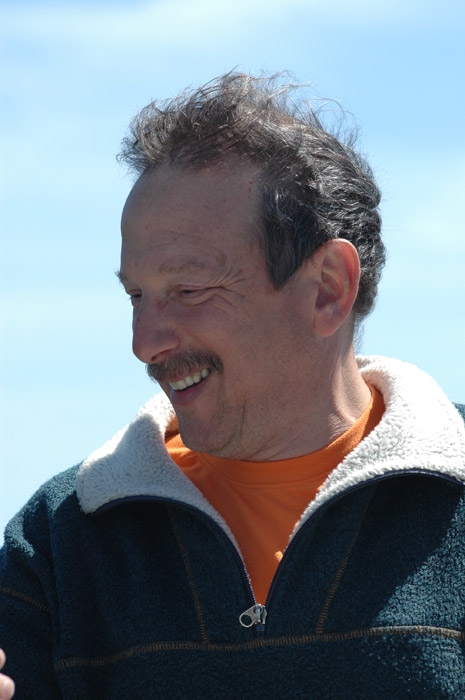 Mark tried unsuccessfully a number of times to lose his hat this weekend. He was psyched as the rest of us at our performance.
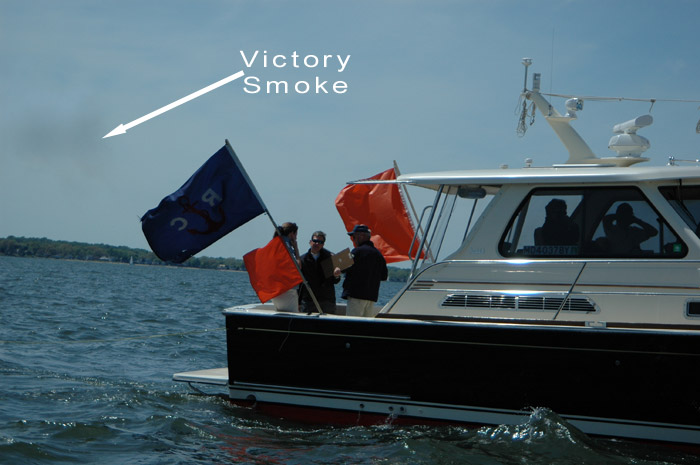 Ahh, the sound of sweet victory! What a great moment. (Even if Brian was a few milliseconds behind with the camera.)
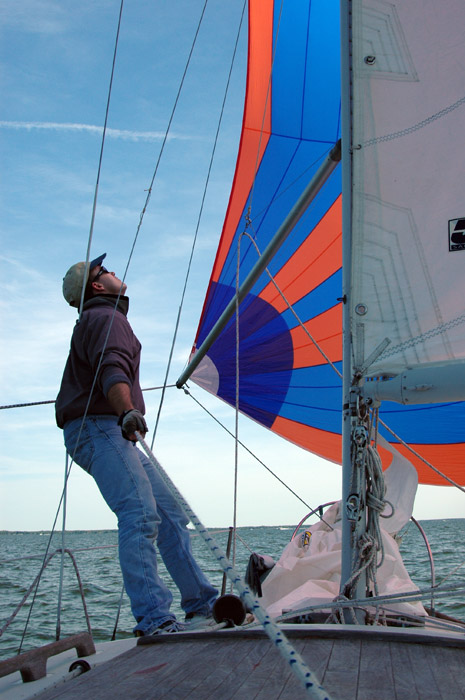 Scott, I'm not saying you should be scared, but Glen is really getting good at foredeck! Check out THE ROCKET!
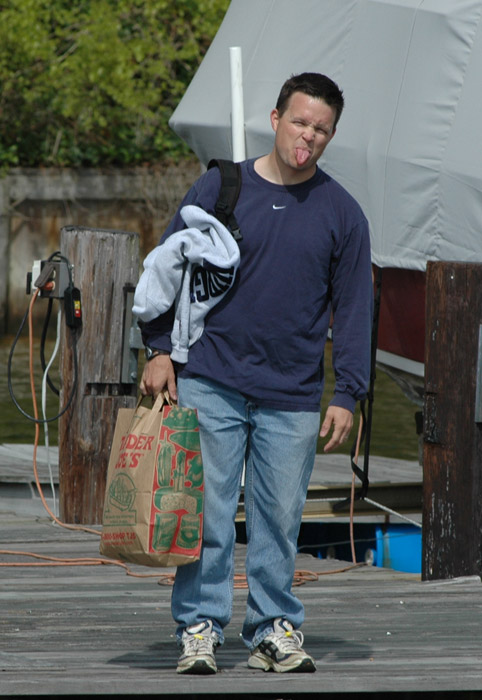 Guess how I felt when I was over an hour late for Sunday's racing?
NOOD Postscript
I went the the post race party to quickly grab our loot and go. I'm not much for these big parties. I when LinGin was called, I made my way forward and took our bag of goodies and noticing C.B. and Towneys' crews sitting up front, went over to congratulate them.
They were all so encouraging and excited for us, and it really made me be proud to be part of this great Alberg 30 class. We were the oldest class in the NOOD. (Did you know that LinGin is 39 years old this year?!) Those guys are very classy and I'm really proud to have them as competitors.
Towney, as many of you know, has a special place in my heart. He is one of the most giving people I have ever known. He will take time, energy and money to help you out, and he'll do it expecting nothing in return. He is one of the best sailors I've ever known, and one of the most humble. (It's actually quite madding at times; I want to know all the technical reasons why he won, but he keeps it very simple.) He's an excellent craftsman as well, and reminds me a great deal of my grandfather in that regard. I have truly enjoyed the time we have spent together working on Alberg projects.
Upon congratulating me with a handclasp, he smiled widely and said, "I'm so sorry! I felt so bad!" I laughed, and told him if there was anyone I was ok with losing to, it was him. I told him how incredible I found it that here he was at 82 (I think that's right), terrorizing us 'kids' less than half his age. I only pray that I am in such great shape at that age. With that he wrapped his arms around me in a big hug, and said, "I love you Timmy". "I love you too, Towney," I said back almost choking up.
That was quite possily one of the most special moments of my life.
--Tim
They were all so encouraging and excited for us, and it really made me be proud to be part of this great Alberg 30 class. We were the oldest class in the NOOD. (Did you know that LinGin is 39 years old this year?!) Those guys are very classy and I'm really proud to have them as competitors.
Towney, as many of you know, has a special place in my heart. He is one of the most giving people I have ever known. He will take time, energy and money to help you out, and he'll do it expecting nothing in return. He is one of the best sailors I've ever known, and one of the most humble. (It's actually quite madding at times; I want to know all the technical reasons why he won, but he keeps it very simple.) He's an excellent craftsman as well, and reminds me a great deal of my grandfather in that regard. I have truly enjoyed the time we have spent together working on Alberg projects.
Upon congratulating me with a handclasp, he smiled widely and said, "I'm so sorry! I felt so bad!" I laughed, and told him if there was anyone I was ok with losing to, it was him. I told him how incredible I found it that here he was at 82 (I think that's right), terrorizing us 'kids' less than half his age. I only pray that I am in such great shape at that age. With that he wrapped his arms around me in a big hug, and said, "I love you Timmy". "I love you too, Towney," I said back almost choking up.
That was quite possily one of the most special moments of my life.
--Tim
2006 NOOD Regatta: A Great Weekend
Crew: Glen, Brian, Mark, Tim and Mike Klassen (new guy!)
Competitors: 550, 57, 247, 501, 562, 484
The NOOD is probably the biggest regatta on the Bay now. Just around 300 boats in four divisions make for quite a weekend. As the first High Point race of the year, it's a very important race for LinGin to place as well as possible.
The NOOD has a couple things going for it:
After a shakedown race on Wednesday night (and getting the gun!), the new spinnaker was ready to go. We wanted to see how she faired in a foot race with Towney or C.B. Good news! She's up to the task. I can't say she's faster, but I can tell you that she will definitely hang with either of those boats.
Crew wise, fate tripped us up on Friday. We had expected to have Brian, Glen and myself all three days, with Mark joining for Fri. and Sat., and Xa joing on Friday. Xa had a server blow up at work early Friday and was dragged into the office. Mark ended up taking his son Adam in for a strep test. It was 10-15 kts. out of the north, and that turned out to be about as much as Glen, Brian and I could hande. We gave Glen a serious workout on the foredeck, but he was up to the challenge, and we did well.
The weather was almost identical everyday: ~10 kts. at 030°, with a killer ~2 kts. ebb tide. All the courses were up, down, up, down and finish. We raced off Hacketts point, south of the Bay Bridge. We went left four out of the five races. It was pretty predictable.
Friday was good day. Much to my amazement, we seemed to have figured out this north wind and heavy current racing condition. Going waaaay up in toward Hacketts Point, we got out of the 30 ft. water and into the 15 ft. water. It make a BIG difference. It looks crazy, though. You look like you've massively overstood the mark, and even as you come back toward it, it looks like you've overstood, but once you get in that 25-30 ft. of water, you slide sideways like mad. We watched C.B. tack three times to round the mark once. (He took three times to cross the starting line once too.) Ouch!
At the end of Friday, we were in 2nd, tied with C.B. and behind Towney. I didn't feel too bad about being behind Towney. He's the master, and if there's anyone I can lose to and feel okay about it, it's Towney.
Saturday we had one race. It was frustrating. We were in 1st rounding the mark for the second time, and with about 2.5 kts. of speed through the water, and being in deep water, went dead downwind toward the finish. About four boat lengths behind, Towney split with us. (We weren't thinking ahead enough to be ready to gybe to cover him.) I felt okay with this, but was a bit nervous because at 2.5 kts., we were at the edge of where downwind gybing might be faster that sailing straight downwind.
A Catalina (the class that started before us) crossed behind us heading left, causing some disruption to us, then gybed back and crossed back no more than 5 minutes later. I was fit to be tied, and said, "Pick a side!!!" He didn't get it, but at least he was gone. A few minutes later we realized the mistake we had made in not planning to cover Towney: he crossed the finish line about 2 boat lengths (if that) on a screaming reach to get the gun. Arghh!
The 2nd race that day had the wind die. We were probably a 1/2 mile ahead for a good portion of the race. It was when we finally got about 3 boat lengths from the mark that the wind died down enough for us to see the true effect of the current: making 2.5 kts. in LinGin (not a bad speed in light air), at 60° to the mark we were making 1 kts. VMG (toward the mark). Unfortunately in the deep water, we were in a 1.5 kts. current! We dropped the anchor and watched the speedometer show 1.5 kts. while we were standing still!
It was kind of interesting to see these races. Most of the races were only 3/4 of a mile from the start to the windward mark. It would take 30-45 minutes to get ot the windward mark, and then about 10 minutes to get back to the leward mark! Glen was whooped by the end of each race between packing the chute, running the lines and setting the pole--not to metion flying the spinnaker.
Saturday night and Sunday morning all I could think about was what we needed to do to beat C.B. Towney was a bit beyond my thinking, but I really wanted to stay ahead of C.B. After going for a run and eating breakfast, I got a call from Glen. "Hey, are you coming today?" he said. "Wait...AM I LATE?!!!" I asked. "Well, I think 1000 is late since we were supposed to leave at 0930," he said calmly. I was freaking out. How could I mess up the time with so much on the line?! I raced around like a mad man, and finally found a house in my neighborhood where I could run out on a dock and be picked up by the crew. Brian has pictures. I was terribly embarrassed. I'm sure there'll be an award at the Annual Dinner for me. :-)
Miraculously we made it with 10 minutes to spare. The first race was tough, and we thought Towney won again--little did we realize C.B. had actually caught him and jeopardized our 2nd place standing. Going into the last race, we traded 1st with C.B. a couple times. Usually, whoever could win the first leg got such a lead going downwind in the current that it was very hard to catch up later. We stayed as close as possible downwind the first leg, and THE ROCKET (along with Glen) held our position against him. When we came around the bottom pin, our rounding caught us up to him. He tacked right in front of us; it was arguble as to whether we should have protested him for tacking too close. Head headed left to the shore, just was we all had so many times before. We stayed inside of him and watched as he slowed and was headed the further he went. By the time we rounded the windward mark, we had a sizeable lead on everyone. We had worked very hard all weekend long to have good pointing and good boatspeed and it had paid off.
Crossing in first we were jubilant! It was such a great ending to the racing. We knew Towney was far behind, but since we thought he had had all bullets (1sts) so far, we had no idea how close we had come to taking 1st. At the post regatta party, I saw the scoring and was blown away. We had tied in points with Towney for first! He beat us because he beat us more times than we had beaten him, but still it was a great feeling. The crew had really clicked, LinGin worked and we had done well.
Thank you Glen, Brian, Mark and Mike (Mike came on Sunday and helped out. It was his first time on LinGin.). All the hard work, training and team work is really paying off. I have high hopes for High Point this year.
I have some awards for you guys!
As for everyone else, we wish you were there with us!
--Tim
Competitors: 550, 57, 247, 501, 562, 484
The NOOD is probably the biggest regatta on the Bay now. Just around 300 boats in four divisions make for quite a weekend. As the first High Point race of the year, it's a very important race for LinGin to place as well as possible.
The NOOD has a couple things going for it:
- Spring weather: there's usually wind
- Lots of boats: the seven Albergs this year was actually a very small number of boats
- Three days of sailing!
After a shakedown race on Wednesday night (and getting the gun!), the new spinnaker was ready to go. We wanted to see how she faired in a foot race with Towney or C.B. Good news! She's up to the task. I can't say she's faster, but I can tell you that she will definitely hang with either of those boats.
Crew wise, fate tripped us up on Friday. We had expected to have Brian, Glen and myself all three days, with Mark joining for Fri. and Sat., and Xa joing on Friday. Xa had a server blow up at work early Friday and was dragged into the office. Mark ended up taking his son Adam in for a strep test. It was 10-15 kts. out of the north, and that turned out to be about as much as Glen, Brian and I could hande. We gave Glen a serious workout on the foredeck, but he was up to the challenge, and we did well.
The weather was almost identical everyday: ~10 kts. at 030°, with a killer ~2 kts. ebb tide. All the courses were up, down, up, down and finish. We raced off Hacketts point, south of the Bay Bridge. We went left four out of the five races. It was pretty predictable.
Friday was good day. Much to my amazement, we seemed to have figured out this north wind and heavy current racing condition. Going waaaay up in toward Hacketts Point, we got out of the 30 ft. water and into the 15 ft. water. It make a BIG difference. It looks crazy, though. You look like you've massively overstood the mark, and even as you come back toward it, it looks like you've overstood, but once you get in that 25-30 ft. of water, you slide sideways like mad. We watched C.B. tack three times to round the mark once. (He took three times to cross the starting line once too.) Ouch!
At the end of Friday, we were in 2nd, tied with C.B. and behind Towney. I didn't feel too bad about being behind Towney. He's the master, and if there's anyone I can lose to and feel okay about it, it's Towney.
Saturday we had one race. It was frustrating. We were in 1st rounding the mark for the second time, and with about 2.5 kts. of speed through the water, and being in deep water, went dead downwind toward the finish. About four boat lengths behind, Towney split with us. (We weren't thinking ahead enough to be ready to gybe to cover him.) I felt okay with this, but was a bit nervous because at 2.5 kts., we were at the edge of where downwind gybing might be faster that sailing straight downwind.
A Catalina (the class that started before us) crossed behind us heading left, causing some disruption to us, then gybed back and crossed back no more than 5 minutes later. I was fit to be tied, and said, "Pick a side!!!" He didn't get it, but at least he was gone. A few minutes later we realized the mistake we had made in not planning to cover Towney: he crossed the finish line about 2 boat lengths (if that) on a screaming reach to get the gun. Arghh!
The 2nd race that day had the wind die. We were probably a 1/2 mile ahead for a good portion of the race. It was when we finally got about 3 boat lengths from the mark that the wind died down enough for us to see the true effect of the current: making 2.5 kts. in LinGin (not a bad speed in light air), at 60° to the mark we were making 1 kts. VMG (toward the mark). Unfortunately in the deep water, we were in a 1.5 kts. current! We dropped the anchor and watched the speedometer show 1.5 kts. while we were standing still!
It was kind of interesting to see these races. Most of the races were only 3/4 of a mile from the start to the windward mark. It would take 30-45 minutes to get ot the windward mark, and then about 10 minutes to get back to the leward mark! Glen was whooped by the end of each race between packing the chute, running the lines and setting the pole--not to metion flying the spinnaker.
Saturday night and Sunday morning all I could think about was what we needed to do to beat C.B. Towney was a bit beyond my thinking, but I really wanted to stay ahead of C.B. After going for a run and eating breakfast, I got a call from Glen. "Hey, are you coming today?" he said. "Wait...AM I LATE?!!!" I asked. "Well, I think 1000 is late since we were supposed to leave at 0930," he said calmly. I was freaking out. How could I mess up the time with so much on the line?! I raced around like a mad man, and finally found a house in my neighborhood where I could run out on a dock and be picked up by the crew. Brian has pictures. I was terribly embarrassed. I'm sure there'll be an award at the Annual Dinner for me. :-)
Miraculously we made it with 10 minutes to spare. The first race was tough, and we thought Towney won again--little did we realize C.B. had actually caught him and jeopardized our 2nd place standing. Going into the last race, we traded 1st with C.B. a couple times. Usually, whoever could win the first leg got such a lead going downwind in the current that it was very hard to catch up later. We stayed as close as possible downwind the first leg, and THE ROCKET (along with Glen) held our position against him. When we came around the bottom pin, our rounding caught us up to him. He tacked right in front of us; it was arguble as to whether we should have protested him for tacking too close. Head headed left to the shore, just was we all had so many times before. We stayed inside of him and watched as he slowed and was headed the further he went. By the time we rounded the windward mark, we had a sizeable lead on everyone. We had worked very hard all weekend long to have good pointing and good boatspeed and it had paid off.
Crossing in first we were jubilant! It was such a great ending to the racing. We knew Towney was far behind, but since we thought he had had all bullets (1sts) so far, we had no idea how close we had come to taking 1st. At the post regatta party, I saw the scoring and was blown away. We had tied in points with Towney for first! He beat us because he beat us more times than we had beaten him, but still it was a great feeling. The crew had really clicked, LinGin worked and we had done well.
Thank you Glen, Brian, Mark and Mike (Mike came on Sunday and helped out. It was his first time on LinGin.). All the hard work, training and team work is really paying off. I have high hopes for High Point this year.
I have some awards for you guys!
As for everyone else, we wish you were there with us!
--Tim
Division: Alberg 30 (7 boats) (top)
| Pos | Sail | Boat | Skipper | 1 | 2 | 3 | 4 | 5 | Total Points | Pos |
| 1 | 550 | Skybird | Townshend, Rolph | 1 | 1 | 1 | 2 | 6 | 11.00 | 1 |
| 2 | 244 | LinGin | Williams, Timothy | 2 | 3 | 2 | 3 | 1 | 11.00 | 2 |
| 3 | 57 | Infinity | Currier, C.B. | 3 | 2 | 3 | 1 | 3 | 12.00 | 3 |
| 4 | 247 | Argo | Williams, T.C. | 5 | 4 | 5 | 6 | 2 | 22.00 | 4 |
| 5 | 501 | Solstice | Morris, Larry | 4 | 5 | 4 | 5 | 5 | 23.00 | 5 |
| 6 | 562 | Windswept | Helms, Lanny | 8/DNF | 6 | 6 | 4 | 4 | 28.00 | 6 |
| 7 | 484 | Second-2-Nun | Gamber, Harold | 8/DNF | 8/DNS | 8/DNC | 8/DNC | 8/DNC | 40.00 | 7 |
Wednesday, April 26, 2006
WNR - Series I - Race 2
(We missed the first race since I was traveling.)
Crew: Glen, Brian P., Nick, Xa, Chuck O'Malley and Tim
Competitors: 550, 247, 484
It was a momentus night in many ways tonight:
We had a tight start, with Harry barging like a crazy man (along with a bunch of boats in other classes). Nick had asked before the race if there were many collisions in these big boats. We said, "no". We came very close to having to eat our words. We, however, squeaked by and ended up right at the boat on the line with enough speed. We started in first and never looked back.
The upwind leg was a straight shot, and on the reach to the next mark, we made out well with the Cals. Chuck had us keep high to force a PHRF class that started late from rolling us.
At that mark we had to give a Cal room. This lead to an excellent discussion about Rule 18: ROUNDING AND PASSING MARKS AND OBSTRUCTIONS on the way home, repleat with great use of the model boats that my son, David, and I built over the winter. BTW: I highly recommend you check out the rules. They're free to download and are found at http://www.ussailing.org/rules/.
The next leg, we made a couple of tacks, then set the spinnaker...I mean THE ROCKET. It was a sight to behold! It looks awesome!
Xa did great job taking us downwind, and we even did a windward douse per Chuck's direction. The crew was pretty enthusiastic, but I really need to get Xa's thoughts on it. It's nice because the chute goes straight into the forward hatch and therefore there are fewer people back in the cockpit area causing trouble.
Tacking into the harbor as the wind lightened up, we maintained our lead and watched as Towney and T.C. dueled it out behind us. Unfortunately, though we got 1st, the gun wasn't functioning so we only got the horn. That's okay because we started the season with a BANG!
A couple thoughts from our coaching with Chuck. (Crew--please leave comments!!!)
--Tim
Crew: Glen, Brian P., Nick, Xa, Chuck O'Malley and Tim
Competitors: 550, 247, 484
It was a momentus night in many ways tonight:
- It was Nick's first race (Nick works with Glen and came out for a Canadian Race last season, but it was cancelled due to too much wind.)
- It was our first race of 2006.
- It was the first time we had Chuck O'Malley of Doyle Sailmakers on board coaching us. (Chuck has made a jib and spinnaker for us.)
- It was our first race with THE ROCKET.
We had a tight start, with Harry barging like a crazy man (along with a bunch of boats in other classes). Nick had asked before the race if there were many collisions in these big boats. We said, "no". We came very close to having to eat our words. We, however, squeaked by and ended up right at the boat on the line with enough speed. We started in first and never looked back.
The upwind leg was a straight shot, and on the reach to the next mark, we made out well with the Cals. Chuck had us keep high to force a PHRF class that started late from rolling us.
At that mark we had to give a Cal room. This lead to an excellent discussion about Rule 18: ROUNDING AND PASSING MARKS AND OBSTRUCTIONS on the way home, repleat with great use of the model boats that my son, David, and I built over the winter. BTW: I highly recommend you check out the rules. They're free to download and are found at http://www.ussailing.org/rules/.
The next leg, we made a couple of tacks, then set the spinnaker...I mean THE ROCKET. It was a sight to behold! It looks awesome!
Xa did great job taking us downwind, and we even did a windward douse per Chuck's direction. The crew was pretty enthusiastic, but I really need to get Xa's thoughts on it. It's nice because the chute goes straight into the forward hatch and therefore there are fewer people back in the cockpit area causing trouble.
Tacking into the harbor as the wind lightened up, we maintained our lead and watched as Towney and T.C. dueled it out behind us. Unfortunately, though we got 1st, the gun wasn't functioning so we only got the horn. That's okay because we started the season with a BANG!
A couple thoughts from our coaching with Chuck. (Crew--please leave comments!!!)
- Glen is going to be focused on strategy this year. I really liked Chuck's steady stream of guidance in short clear terms. It was really helpful.
- Backstay tension is important especially in heavy air. Chuck saw headstay sag during our upwind sailing, which leads to overpowering and poor pointing.
- Bring the traveller up in lighter air, down in heavier air.
- Tighten the main shrouds 2 turns to help tighten the rig.
- Consider the windward chute take down.
- There's more I know I'm forgetting...
--Tim
Thursday, April 13, 2006
And the Winner Is...
What a great showing of artistic talent! Thank you everyone that sent in designs. I have to admit that this Brian Palmer design was very tempting.

Something about a picture of me the size of a barn seems very threatening, if not completely distracting. I just find it hard to believe that C.B. or anyone else would be able to concentrate with Scott flying the "Tim Chute", bearing down on them.
Andréa, however, brought me back to earth. As much as she would enjoy a picture of me the size of a barn floating around the Bay, she said it just wouldn't be right. So...
I took ideas from each of you to come up with the design below and I'm shipping it off to Chuck O'Malley at Doyle today.

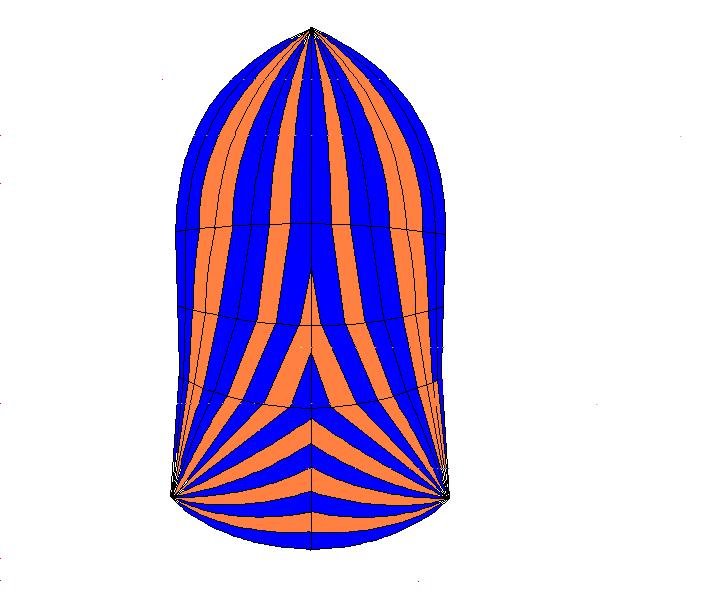
I call it "LinGin: The Rocket". I didn't want people to say, "here comes the Effiel Tower", and while, "look at Darth Vader" sounds kinda cool, I thought, "LOOK OUT! Here comes THE ROCKET!" was best. What do you think? Does it look fast? (Lie if you can't say something positive.)
Also, get this, Chuck said he plans to have the sail ready for the 2nd WNR and he'll be along for the ride to coach us on it and the jib. So mark your calendars for April 26th, and be prepared to go fast!
--Tim
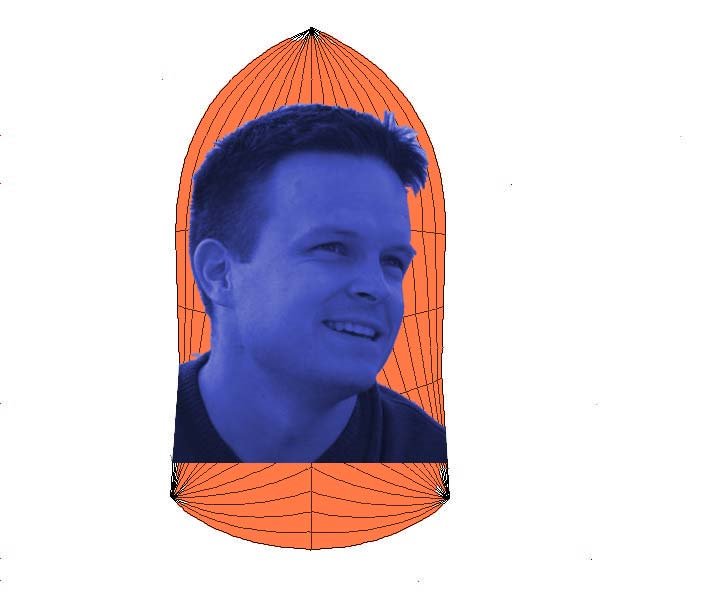
Something about a picture of me the size of a barn seems very threatening, if not completely distracting. I just find it hard to believe that C.B. or anyone else would be able to concentrate with Scott flying the "Tim Chute", bearing down on them.
Andréa, however, brought me back to earth. As much as she would enjoy a picture of me the size of a barn floating around the Bay, she said it just wouldn't be right. So...
I took ideas from each of you to come up with the design below and I'm shipping it off to Chuck O'Malley at Doyle today.
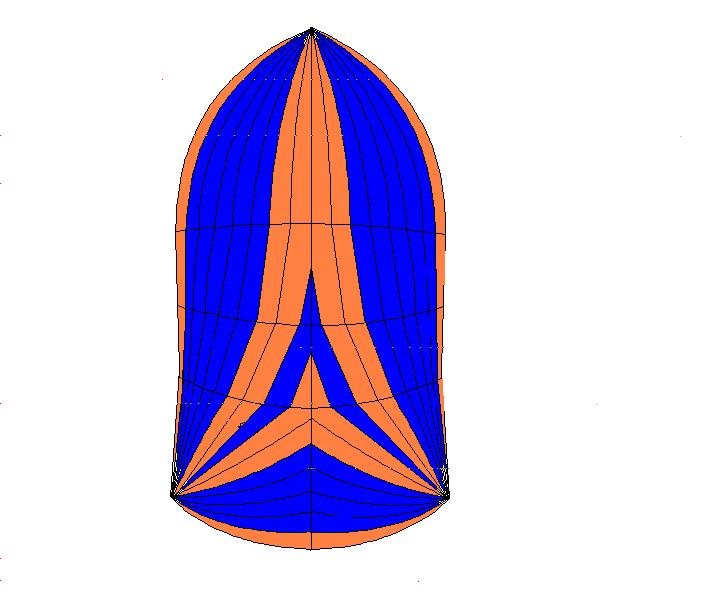
I call it "LinGin: The Rocket". I didn't want people to say, "here comes the Effiel Tower", and while, "look at Darth Vader" sounds kinda cool, I thought, "LOOK OUT! Here comes THE ROCKET!" was best. What do you think? Does it look fast? (Lie if you can't say something positive.)
Also, get this, Chuck said he plans to have the sail ready for the 2nd WNR and he'll be along for the ride to coach us on it and the jib. So mark your calendars for April 26th, and be prepared to go fast!
--Tim
Tuesday, April 11, 2006
Dedication to Winning
Well Crew, I have a surprise for you. Perhaps foolishly, I have decided to invest in a new spinnaker. Last season, I truly felt that we lost out to C.B. a number of times due to our spinnaker. I felt we did a great job trimming, and more than once--on very long legs--we could not hold with Infinity. I recall we all discussed the fact that C.B.'s design is one with big "shoulders"; better for "deeper" downwind legs. So, I have decided to take the plunge.
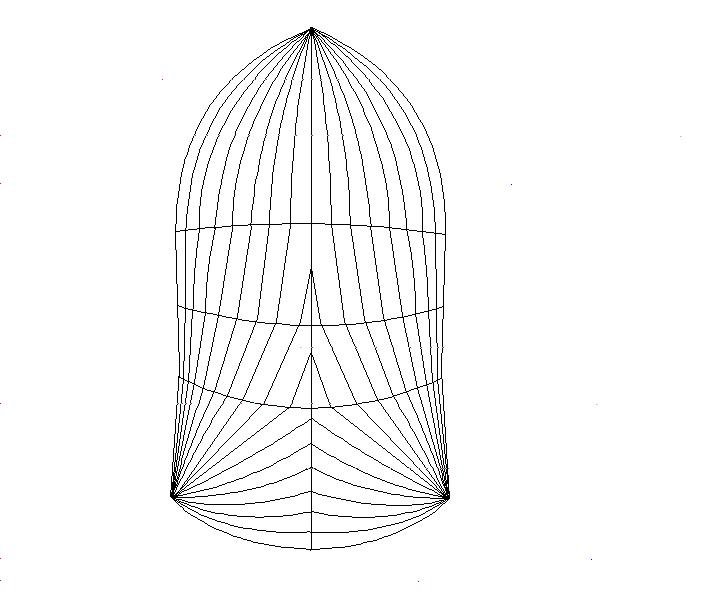
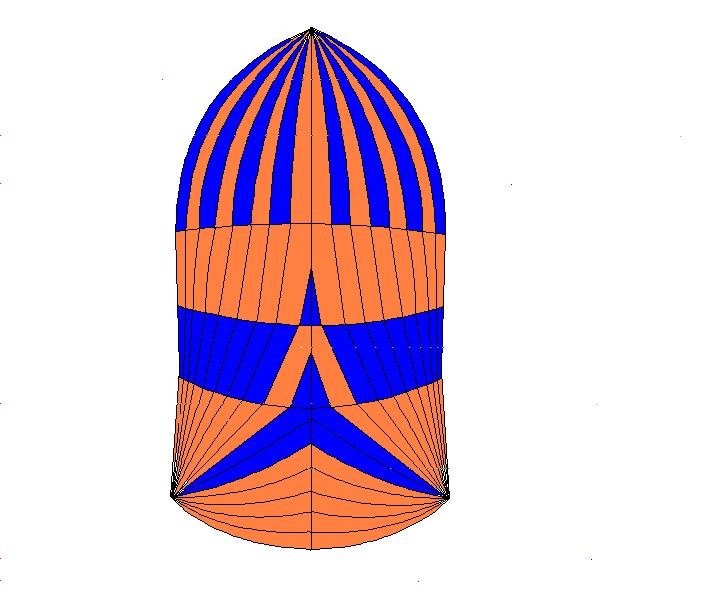
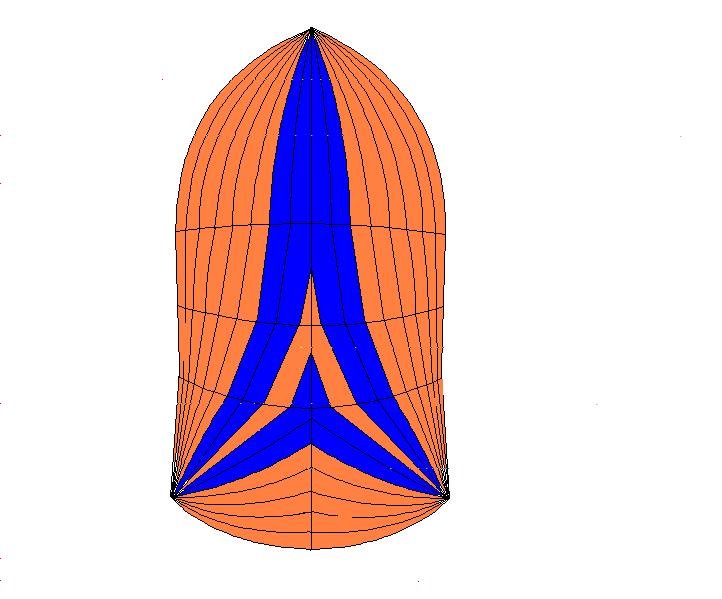
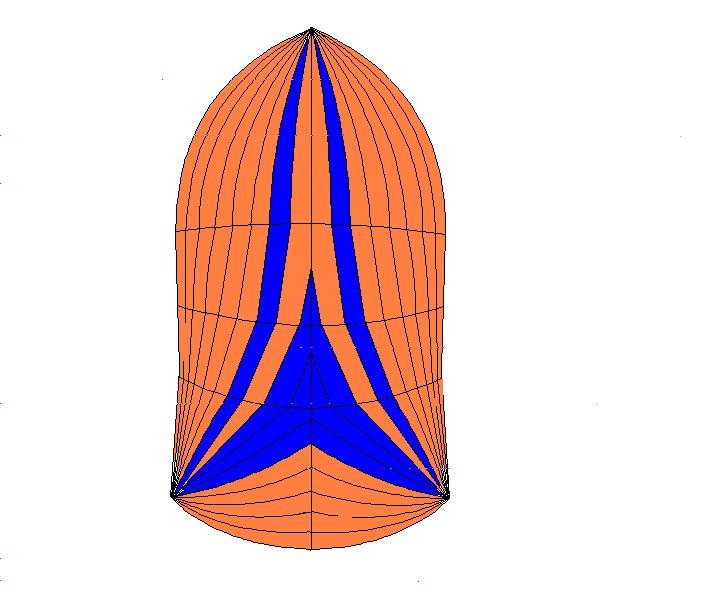
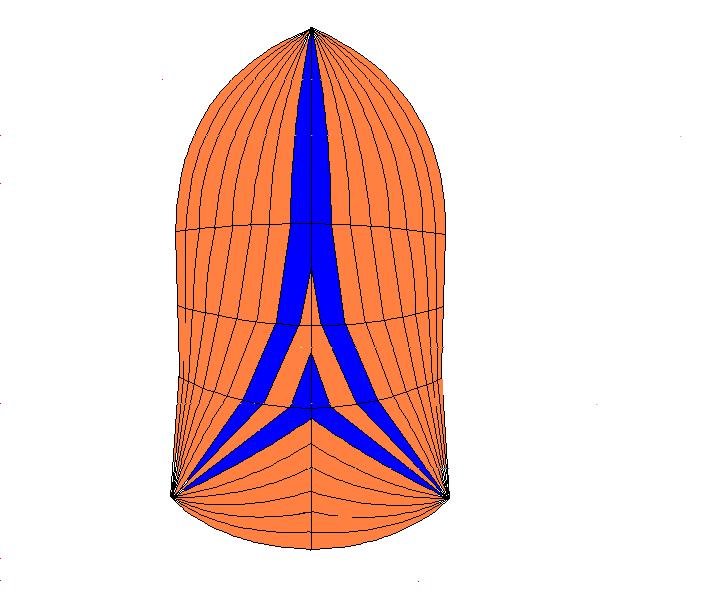
I need some quick help. We need a color design by tomorrow! I'm posting some designs I've done today and the blank. Grab the blank, throw it in paint (or a similar app) and show us what you like. Or just chose one of mine. I think I'd like to stick with blue and orange, but I'm not 100% stuck on it. Also, I'd prefer lighter to darker colors.
--Tim


I need some quick help. We need a color design by tomorrow! I'm posting some designs I've done today and the blank. Grab the blank, throw it in paint (or a similar app) and show us what you like. Or just chose one of mine. I think I'd like to stick with blue and orange, but I'm not 100% stuck on it. Also, I'd prefer lighter to darker colors.
--Tim
Thursday, March 16, 2006
Get Your Head Out of the Boat!
One point Dave Perry emphasized at the seminar that really stuck with me is the importance of the driver not doing the strategy. His point was that to effectively do strategy, you must have your head out of the boat. The helmsman, by definition, needs to be zeroed in on the boat and not the boats around him.
This has hurt us many times in races, and I think it’s an advantage that C.B. and Towney have on us. They simply have some seasoned veterans on board that give them a leg up.
Now, while I may have the most racing experience on board, I would prefer to remain driver and not strategist. Two reasons:
I am confident that we can develop our team into solid strategists. To that end, I’d like to create lots of communication about strategy—both pre and post race. I also think the “LinGin Book Club” could be a great place to make this happen.
This has hurt us many times in races, and I think it’s an advantage that C.B. and Towney have on us. They simply have some seasoned veterans on board that give them a leg up.
Now, while I may have the most racing experience on board, I would prefer to remain driver and not strategist. Two reasons:
- Driving an Alberg takes finesse that develops over time. I have a lot of Alberg helm time, and I enjoy that advantage!
- I really like driving. It’s a thrill to me, and while I like strategy, on the whole I like driving more.
I am confident that we can develop our team into solid strategists. To that end, I’d like to create lots of communication about strategy—both pre and post race. I also think the “LinGin Book Club” could be a great place to make this happen.
Wednesday, March 15, 2006
Sailing Education
As we all know, there’s a lot to learn in sailing!
In that regard, I read books, subscribe to magazines and even attend workshops to learn more about this sport that I love.
I’d like to get anyone that’s interested more involved with these learning opportunities. Here are a couple recommendations that I have:
1. Subscribe to the Speed & Smarts newsletter. I can hook you up for 15% off, $34/yr. It has no ads, is well laid out, and does not assume too much racing knowledge. If you have trouble finding time for books, or getting through whole books in a reasonable time (as I do), this could be a godsend. It covers one topic per issue and is usually 15 pages long.
2. Buy a good sailing book. The North U books are great, as are the books by Dave Perry. I highly recommend both.
3. I’d like to gauge interest in a regular crew meeting, the “LinGin Book Club”. Perhaps a breakfast or a lunch once a week or every other week. We would select a chapter from a book (or perhaps a Speed & Smarts issue) to discuss each meeting.
What are your thoughts?
In that regard, I read books, subscribe to magazines and even attend workshops to learn more about this sport that I love.
I’d like to get anyone that’s interested more involved with these learning opportunities. Here are a couple recommendations that I have:
1. Subscribe to the Speed & Smarts newsletter. I can hook you up for 15% off, $34/yr. It has no ads, is well laid out, and does not assume too much racing knowledge. If you have trouble finding time for books, or getting through whole books in a reasonable time (as I do), this could be a godsend. It covers one topic per issue and is usually 15 pages long.
2. Buy a good sailing book. The North U books are great, as are the books by Dave Perry. I highly recommend both.
3. I’d like to gauge interest in a regular crew meeting, the “LinGin Book Club”. Perhaps a breakfast or a lunch once a week or every other week. We would select a chapter from a book (or perhaps a Speed & Smarts issue) to discuss each meeting.
What are your thoughts?
Tuesday, March 14, 2006
Sailing Rules: A LinGin Focus in 2006
I attended a Dave Perry rules seminar this winter at SSA. He’s quite a character; very easy going and very funny. I had a blast and would definitely recommend taking any opportunity to see him that you get. (This was an SSA members-only event, or I would have invited everyone.)
Rules are something I’d really like to emphasize this season. At the outset, they look and sound overwhelming, but went you break them down, they’re not too bad. I think the best way for us to learn them is use the racing situations we see on the course.
In that regard, David (my son) and I are going to build a mini-magnetic boat set for us to use on LinGin to diagram different situations that we can discuss on the way to and/or from races. I’ll bring the 2005-2008 rules with us, and we can work through the basic ones.
Also, I highly recommend considering a membership in US Sailing (www.ussailing.org). It’s our national organizing body, and a very important part of our sport. When you join you get a copy of the current rules.
Rules are something I’d really like to emphasize this season. At the outset, they look and sound overwhelming, but went you break them down, they’re not too bad. I think the best way for us to learn them is use the racing situations we see on the course.
In that regard, David (my son) and I are going to build a mini-magnetic boat set for us to use on LinGin to diagram different situations that we can discuss on the way to and/or from races. I’ll bring the 2005-2008 rules with us, and we can work through the basic ones.
Also, I highly recommend considering a membership in US Sailing (www.ussailing.org). It’s our national organizing body, and a very important part of our sport. When you join you get a copy of the current rules.
Saturday, March 11, 2006
The Magical T-Bar
So the 2006 Sailing Season is nearly upon us, and while basically nothing has been done to LinGin in the off season, I’ve thought a lot about what needs to be done, and I’m really looking forward to the season.
Glen and I get together every Friday for breakfast, and we’ve had some good discussions about this season. I’d like to get everyone involved.
I read an article in Sailing World about “the T-bar”. This is a simple concept to help one develop an awareness of what his strengths and weakness are. It looks like this:

Hopefully, you see the gray “T” (hence the name T-bar). The strengths and weaknesses are ordering in descending severity. So the weakness a the top of the list is your worst weakness, and the one at the bottom your least troublesome weakness. Got it?
The key to leveraging the T-bar is to spend the most time practicing your worst weakness. It’s human nature to enjoy spending time doing that which you are good at, and to avoid doing that which you struggle with. However, your biggest gains for the smallest time investment will come from practicing that area in which you have the most to improve.
My challenge to you is to help me develop as an accurate T-bar for the LinGin crew as possible. Please post comments to this blog entry and I’ll add/modify the list as we come to agreement on this.
Then we can work on those items, and rock the fleet this summer!
Glen and I get together every Friday for breakfast, and we’ve had some good discussions about this season. I’d like to get everyone involved.
I read an article in Sailing World about “the T-bar”. This is a simple concept to help one develop an awareness of what his strengths and weakness are. It looks like this:
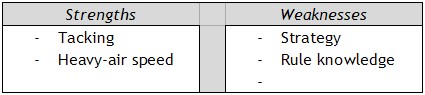
Hopefully, you see the gray “T” (hence the name T-bar). The strengths and weaknesses are ordering in descending severity. So the weakness a the top of the list is your worst weakness, and the one at the bottom your least troublesome weakness. Got it?
The key to leveraging the T-bar is to spend the most time practicing your worst weakness. It’s human nature to enjoy spending time doing that which you are good at, and to avoid doing that which you struggle with. However, your biggest gains for the smallest time investment will come from practicing that area in which you have the most to improve.
My challenge to you is to help me develop as an accurate T-bar for the LinGin crew as possible. Please post comments to this blog entry and I’ll add/modify the list as we come to agreement on this.
Then we can work on those items, and rock the fleet this summer!
Wednesday, October 26, 2005
Queenstown
A raucous afternoon poker game lead to an enjoyable dinner cooked by Mr. Whaley. Spaghetti and salad (cooked with directions from Crystal) turned out great. FYI: After actually carrying the poker set around, I have decided to forbid it on any more races; it must weigh 30 lbs!
:-)
The next morning the wind was out of the north, making the race a spinnaker start. Circling around and coming across the line with speed, we had a great start leading the pack. CB, with his big spinnaker, took us over before the next mark, and as the spinnaker was flown for the rest of the race, Scott lead the charge to catch 'em.
Having spent a fair amount of the summer look at CB's spinnaker going by us, I feel pretty confident that it has bigger "shoulders" than ours. I'm convinced that makes a pretty big difference downwind--especially the closer to dead downwind you are.
It was a valent effort, and as the last leg had us on a pretty tight reach, we started to catch CB. Were we catching him fast enough, though?
With a sudden *TWANG*, the port spinnaker turning block exploded, shooting the sheave over my left ear and about 30 feet in front of the boat! With some quick work, we were able to keep things going, but we lots our opportunity to catch Infinty.
Needless to say, since the same block had come apart its first day on the job during the NOOD I was frustrated to have it happen again. I'm working with Fawcetts to come up with a solution...
We enjoyed a nice sail back home. It was a day well spent on the water with good friends.
TC went high for some unknown reason.
--Tim
Tuesday, October 25, 2005
Canadians
The Bruce Rankin Memorial Regatta 2005
(A.K.A. The Canadian Race)
Crew: Glen, Brian P., Tim
Competitors: 247, 57, 484, 550, and others for a total of 13!
Saturday turned out to be very breezy, with steady winds in the high teens and 25kts+ at times. I can't tell you how happy Glen and I were to see Brian show up at the dock that morning. Scott had to spend the day at work, and Brian had signaled he might not make it either. That would have been disastrous given the conditions.
The first race we had came in 4th. We actually caught a bunch of boats coming down wind, but with a poor
rounding, and poor upwind performance fell from 2nd to 4th.
The second race was very frustrating. As we were starting, coming to the pin end of the line on spinnaker, with a bunch of boats to windward of us and 247 to leeward, 247 tacked onto port directly in front of us. I went nuts because the only option at that point was to bear off and do a gybe, crossing on port behind the whole fleet. TC (247) was very apologetic and did his circles, but it still put us in a very bad spot.
After duking it out around the course, we caught all the way up to second again (Towney was way ahead) at the leeward mark. As we made our way to the finish line, the wind went to 25kts+. With the no. 1 up and no reef, Brian and Glen did some quick work to reef the main. I didn't do a good job dealing with the excess wind, and not only did we fall to 5th, we lost by a hair to TC. I was pretty frustrated.
One thing I think we need to figure out is how to reduce upwind power. Other boats are pointing better, and are carrying their sails more fully than we are. I think there are two things we need to consider:
1. We need to consider ways to better flatten the new jib. I think we need to throw out some of our old thinking it how to set it up. It's a different cut than our old sail.
2. We need the boom vang installed. I think flattening the main a much as we can will make a big difference.
Even with the poor performance, it was a good time. Brian caught up on some much needed sleep on the way home, and Glen and I enjoyed the afternoon, tired, but satisfied.
Sundays race was cancelled due to access wind. It was blowing steady 25kts+ and with borrowed boats on the course, the RC decided to send us in. A definite bummer, but the right call.
--Tim
Thursday, September 29, 2005
Race back from Oxford 2005
(The Hammond Memorial Regatta)
Crew: Glen, Brian P., Tim
Competitors: 247, 57, 484
After a good night's rest in a borrowed slip, we grabbed some food and coffee and headed to the start. Thankfully there was more wind than Saturday--but not much.
The start was downwind, and without Scott, we did our best. (No offense, Brian!) We ran the line on starboard and bore off to set the chute. C.B. decided to port tact the fleet, and set his chute early. With speed, a wide line, and few boats to contend with, C.B. had a nice start in first place. We started in front of T.C., but he soon caught up and passed us by gybing out from under us.
At this point C.B. and T.C. continued tp head to the left on port and we stayed pretty much on the rhumb line since we had enough breeze to make 2 kts. T.C. motored to the first mark beating C.B. in the process. No one is sure why that happened.
We were probably 30 boat lengths behind C.B. at this point and feeling pretty bad. However, the wind was on and off again, and shifty at that. We did our best to pay attention to the shifts (some of them 30°), and by keeping track of them, we were able to make some good tacking decisions.
By the next mark, the standings had reversed, and we were in the lead. Fortunately we had lead enough to cover C.B. to the end while barely making the finish by the time limit.
While not a lot of wind, there was enough. The crew did a great job and it was nice to get the gun!
(The Hammond Memorial Regatta)
Crew: Glen, Brian P., Tim
Competitors: 247, 57, 484
After a good night's rest in a borrowed slip, we grabbed some food and coffee and headed to the start. Thankfully there was more wind than Saturday--but not much.
The start was downwind, and without Scott, we did our best. (No offense, Brian!) We ran the line on starboard and bore off to set the chute. C.B. decided to port tact the fleet, and set his chute early. With speed, a wide line, and few boats to contend with, C.B. had a nice start in first place. We started in front of T.C., but he soon caught up and passed us by gybing out from under us.
At this point C.B. and T.C. continued tp head to the left on port and we stayed pretty much on the rhumb line since we had enough breeze to make 2 kts. T.C. motored to the first mark beating C.B. in the process. No one is sure why that happened.
We were probably 30 boat lengths behind C.B. at this point and feeling pretty bad. However, the wind was on and off again, and shifty at that. We did our best to pay attention to the shifts (some of them 30°), and by keeping track of them, we were able to make some good tacking decisions.
By the next mark, the standings had reversed, and we were in the lead. Fortunately we had lead enough to cover C.B. to the end while barely making the finish by the time limit.
While not a lot of wind, there was enough. The crew did a great job and it was nice to get the gun!
Friday, September 23, 2005
Race to Oxford 2005
Crew: Glen, Brian P., Tim
Competitors: 247, 57, 484
Oxford last year (2004) was a story that will be told for the rest of our lives. 55MPH winds, 6+ ft. waves, and watching the GPS show LinGin moving 14MPH. And that doesn't even touch on snapping the tiller in the middle of the race.
This year, however, things could not be more different. The race committee announced shortly before the start that while there was almost no wind, they would start us anyway because the current would be pushing us toward Oxford.
We sited the line, and quickly found ourselves on course side, running out of time to get behind the line for the start. With some scrambling, and a little more breeze, we made it behind the line and actually started in the lead.
C.B. and T.C. headed for the eastern shore, while we opted for the rhumb line along with Harry. It was very sunny out all day, and shortly after the start at 0900, the wind began to pick up out of the north. We set a chute and saw 8kts of breeze. We were feeling good and looked to be leading the fleet.
As we approached the first mark, C.B. came back from the eastern shore and began to converge with us. The wind was now down to 2-3 kts, and it was clear we were ahead only by a couple boat lengths.
We were soon in a downwind duel with C.B. and considering we were missing our foredeckman, had only 3 people sailing the boat and there was almost no wind, I felt we did really well holding him off. After about fifteen minutes of duking it out, C.B. was able to gybe out from us and we decided to part ways.
The wind proceeded to drop to <1 kt, and Glen went below to get "Trim" by Bill Gladstone. Based on Gladstone's instructions, we set the boat for exteremely light air speed. Interestingly, Gladstone suggests that at some point, you move from boat set up to "go play golf". We wondered many times over the next four or five hours if we had hit "go play golf" windspeeds.
Persisting in very light air, we basically trimmed for speed, and tried to tack on the headers. The current was not much of a factor during this time as it was with us.
We were sure that the Race Committee (RC) would shorten the course and end our misery, but with each mark we passed, it became more apparently the would not.
Finally around 1800, with roughly 5 miles to go and in literally 0 kts of wind, we abandoned the helm and started working on boat projects. We installed the newly created spinnaker pole holders. Glen whipped the ends of our new light air jib sheet. We listened on the radio to hear the Catalinas argue as to what dropping out would do to their hight point standings.
We were committed not to quit before C.B., who by now we had managed to get ahead of again. About the time the Catalinas agreed to all quit, C.B. started his engine and motored in. We did the same.
I cannot tell you how angry everyone was at the RC. We had started at 0900 and 9 hours later all dropped out after baking in the sun and wrestling with light air all day. We could have had a race count if the RC had just gotten off their lazy butts and finished us.
Brian and Glen did an outstanding job, working tirelessly to keep the boat moving even in extreme heat and little air. It was a pleasure to be part of the team.
There's always next year.
--Tim
Crew: Glen, Brian P., Tim
Competitors: 247, 57, 484
Oxford last year (2004) was a story that will be told for the rest of our lives. 55MPH winds, 6+ ft. waves, and watching the GPS show LinGin moving 14MPH. And that doesn't even touch on snapping the tiller in the middle of the race.
This year, however, things could not be more different. The race committee announced shortly before the start that while there was almost no wind, they would start us anyway because the current would be pushing us toward Oxford.
We sited the line, and quickly found ourselves on course side, running out of time to get behind the line for the start. With some scrambling, and a little more breeze, we made it behind the line and actually started in the lead.
C.B. and T.C. headed for the eastern shore, while we opted for the rhumb line along with Harry. It was very sunny out all day, and shortly after the start at 0900, the wind began to pick up out of the north. We set a chute and saw 8kts of breeze. We were feeling good and looked to be leading the fleet.
As we approached the first mark, C.B. came back from the eastern shore and began to converge with us. The wind was now down to 2-3 kts, and it was clear we were ahead only by a couple boat lengths.
We were soon in a downwind duel with C.B. and considering we were missing our foredeckman, had only 3 people sailing the boat and there was almost no wind, I felt we did really well holding him off. After about fifteen minutes of duking it out, C.B. was able to gybe out from us and we decided to part ways.
The wind proceeded to drop to <1 kt, and Glen went below to get "Trim" by Bill Gladstone. Based on Gladstone's instructions, we set the boat for exteremely light air speed. Interestingly, Gladstone suggests that at some point, you move from boat set up to "go play golf". We wondered many times over the next four or five hours if we had hit "go play golf" windspeeds.
Persisting in very light air, we basically trimmed for speed, and tried to tack on the headers. The current was not much of a factor during this time as it was with us.
We were sure that the Race Committee (RC) would shorten the course and end our misery, but with each mark we passed, it became more apparently the would not.
Finally around 1800, with roughly 5 miles to go and in literally 0 kts of wind, we abandoned the helm and started working on boat projects. We installed the newly created spinnaker pole holders. Glen whipped the ends of our new light air jib sheet. We listened on the radio to hear the Catalinas argue as to what dropping out would do to their hight point standings.
We were committed not to quit before C.B., who by now we had managed to get ahead of again. About the time the Catalinas agreed to all quit, C.B. started his engine and motored in. We did the same.
I cannot tell you how angry everyone was at the RC. We had started at 0900 and 9 hours later all dropped out after baking in the sun and wrestling with light air all day. We could have had a race count if the RC had just gotten off their lazy butts and finished us.
Brian and Glen did an outstanding job, working tirelessly to keep the boat moving even in extreme heat and little air. It was a pleasure to be part of the team.
There's always next year.
--Tim
Wednesday, September 07, 2005
WNR - Series III - Race 5
Crew: Glen, Brian P., Scott, Pat
Competitors: 247, 550, 484
Heading over to the race, there were low clouds and a stiff breeze out of the southwest. In a bit of a rush, we took a bit of a short cut and shot straight from the red marker at the entrance to Whitehall Bay over to the yellow channel marker next to the spider buoy. Note to crew: it worked well and didn't look too shallow not to do all the time.
Soon after rounding the spider, we had a great time watching the Etchells scream off the starting line under spinnaker. Within 5 minutes, there were at least 3 chutes ripped--including the boat leading the fleet. Scott was excited to get ready for what looked like it would be an adrenaline-pumping start.
We started well at the boat end, and wanted to stay high to keep clear air, and based on the angle of the wind, we wanted to go high for a bit to be able to bear off and set the chute. (It was a close call as to whether we would be able to hold the chute right off the line.) Our course was out to a mark nearly in line with the channel markers. Towney started at the pin end in clear air, but with an angle that didn't let him immediately set his chute.
After about 5-10 minutes under jib, we set the chute leading a pack of Catalina 25s. We successfully fended off a couple of them trying to go high of us by luffing one of them up, and then came back down to course. Towney set his chute and we were both cooking, but the wind had died down from what it was at the Etchells start.
Shortly before the mark, the wind picked up again. The C25s started to lose control, and since we were about 15 boat-lengths to the mark, we decided to douse as well. We were neck and neck with Towney at this point, and he took down his chute at the same time. Now it was time to see who could do a controlled gybe, not get hit by an out of control C25, and beat the other around the mark!
Our gybe was good, but the boom rose and caught the backstay. A potentially dangerous situation: 1. we could have damaged the backstay, and 2. we were immediately rounded up, and while the Alberg rudder is big, it's not big enough to overpower the main in 20+ kts of wind. Thankfully I was able to keep from ramming the C25s, and the crew was able to get the boom off the backstay. However, Towney took advantage of the situation and rounded inside of us. We gave two C25s room and took off after Towney.
With the dramatic increase in wind speed, we knew we would be overpowered with the No. 1 and even a reefed main. I figured Towney would not be in a mood to do a headsail change, so I took a chance and ordered the change to the No. 2. It was a risky move since it meant sailing without a headsail for roughly a minute while the new one was brought up. Would we have enough distance in the WNR to not only catch up to Towney, but make up the ground lost during the change?
I was reminded of the Hammond Memorial race from last year during this exercise. We had ripped our No. 2 and were forced to use the No. 1 most of the race, overpowered the whole way. In the end, the decision bore out my guess: we caught up to Towney by the red nun.
At this point, we started sailing very conservatively, covering his every move. After watching him for awhile, we started to suspect that he had a mechanical problem with the boat, too. At one point he did a gybe going up wind rather than a tack. Very strange. I plan to ask him about it next time I see him.
We hustled all the way in and took the gun! A GREAT race, and lots of fun.
Postscript
Seeing as it was a beautiful night: cool, 15+ kts of breeze and a sunset that was incredible, we decided to kill the noisy, stinky engine and sail home. It was fantastic there were low, local clouds that darkened the sky, but since the clouds did not cover the horizon, the sunset lit up the underside of the clouds in a way that was incredibly beautiful. Both Brian and I were kicking ourselves for not bringing our cameras. I did my very best to soak in this incredible view and feeling. I could not think of a better place to be in the world than right there at that moment. It was wonderful.
Coming into Whitehall Creek, it had become dark and we continued sailing. At the first red unlit mark, we tacked and *BAM* ran aground before we could make a move. We all hopped to one side, but I'm pretty sure that between the wind blowing us and a swift ebb tide, we became rapidly and hopelessly hard aground.
First we tried kedging. (Throwing an anchor out and trying to pull the boat off.) Then Glen jumped into a sea of jellyfish and tried pushing. Then Glen swam the anchor as far out as possible to get a better pulling angle. Then Scott jumped in and while being stung, helped Glen push while we kedged. Finally we tried taking the spin halyard, tying it to the anchor line and kedging. All this to no avail.
I jumped in to help (got stung), and while I was pushing we saw a sailboat coming. We had now been aground for about 2 1/2 hours and this was the first vessel to come by. They were willing to help, but were afraid to get close, so Glen swam them over a line. (He was stung in the ear while doing this.) They pulled us once, and then threw Glen back in, changed position, grabbed Glen, and finally pulled us off.
Hats off to Glen for all his hard work. He said he had never been stung before. Talk about being into new experiences...
And after all this, I had to drive to Philly that night for work. Needless to say, I arrived at 0200. But even with all that, it was one of the most beautiful sailing nights I can remember. And I loved it.
--Tim
Crew: Glen, Brian P., Scott, Pat
Competitors: 247, 550, 484
Heading over to the race, there were low clouds and a stiff breeze out of the southwest. In a bit of a rush, we took a bit of a short cut and shot straight from the red marker at the entrance to Whitehall Bay over to the yellow channel marker next to the spider buoy. Note to crew: it worked well and didn't look too shallow not to do all the time.
Soon after rounding the spider, we had a great time watching the Etchells scream off the starting line under spinnaker. Within 5 minutes, there were at least 3 chutes ripped--including the boat leading the fleet. Scott was excited to get ready for what looked like it would be an adrenaline-pumping start.
We started well at the boat end, and wanted to stay high to keep clear air, and based on the angle of the wind, we wanted to go high for a bit to be able to bear off and set the chute. (It was a close call as to whether we would be able to hold the chute right off the line.) Our course was out to a mark nearly in line with the channel markers. Towney started at the pin end in clear air, but with an angle that didn't let him immediately set his chute.
After about 5-10 minutes under jib, we set the chute leading a pack of Catalina 25s. We successfully fended off a couple of them trying to go high of us by luffing one of them up, and then came back down to course. Towney set his chute and we were both cooking, but the wind had died down from what it was at the Etchells start.
Shortly before the mark, the wind picked up again. The C25s started to lose control, and since we were about 15 boat-lengths to the mark, we decided to douse as well. We were neck and neck with Towney at this point, and he took down his chute at the same time. Now it was time to see who could do a controlled gybe, not get hit by an out of control C25, and beat the other around the mark!
Our gybe was good, but the boom rose and caught the backstay. A potentially dangerous situation: 1. we could have damaged the backstay, and 2. we were immediately rounded up, and while the Alberg rudder is big, it's not big enough to overpower the main in 20+ kts of wind. Thankfully I was able to keep from ramming the C25s, and the crew was able to get the boom off the backstay. However, Towney took advantage of the situation and rounded inside of us. We gave two C25s room and took off after Towney.
With the dramatic increase in wind speed, we knew we would be overpowered with the No. 1 and even a reefed main. I figured Towney would not be in a mood to do a headsail change, so I took a chance and ordered the change to the No. 2. It was a risky move since it meant sailing without a headsail for roughly a minute while the new one was brought up. Would we have enough distance in the WNR to not only catch up to Towney, but make up the ground lost during the change?
I was reminded of the Hammond Memorial race from last year during this exercise. We had ripped our No. 2 and were forced to use the No. 1 most of the race, overpowered the whole way. In the end, the decision bore out my guess: we caught up to Towney by the red nun.
At this point, we started sailing very conservatively, covering his every move. After watching him for awhile, we started to suspect that he had a mechanical problem with the boat, too. At one point he did a gybe going up wind rather than a tack. Very strange. I plan to ask him about it next time I see him.
We hustled all the way in and took the gun! A GREAT race, and lots of fun.
Postscript
Seeing as it was a beautiful night: cool, 15+ kts of breeze and a sunset that was incredible, we decided to kill the noisy, stinky engine and sail home. It was fantastic there were low, local clouds that darkened the sky, but since the clouds did not cover the horizon, the sunset lit up the underside of the clouds in a way that was incredibly beautiful. Both Brian and I were kicking ourselves for not bringing our cameras. I did my very best to soak in this incredible view and feeling. I could not think of a better place to be in the world than right there at that moment. It was wonderful.
Coming into Whitehall Creek, it had become dark and we continued sailing. At the first red unlit mark, we tacked and *BAM* ran aground before we could make a move. We all hopped to one side, but I'm pretty sure that between the wind blowing us and a swift ebb tide, we became rapidly and hopelessly hard aground.
First we tried kedging. (Throwing an anchor out and trying to pull the boat off.) Then Glen jumped into a sea of jellyfish and tried pushing. Then Glen swam the anchor as far out as possible to get a better pulling angle. Then Scott jumped in and while being stung, helped Glen push while we kedged. Finally we tried taking the spin halyard, tying it to the anchor line and kedging. All this to no avail.
I jumped in to help (got stung), and while I was pushing we saw a sailboat coming. We had now been aground for about 2 1/2 hours and this was the first vessel to come by. They were willing to help, but were afraid to get close, so Glen swam them over a line. (He was stung in the ear while doing this.) They pulled us once, and then threw Glen back in, changed position, grabbed Glen, and finally pulled us off.
Hats off to Glen for all his hard work. He said he had never been stung before. Talk about being into new experiences...
And after all this, I had to drive to Philly that night for work. Needless to say, I arrived at 0200. But even with all that, it was one of the most beautiful sailing nights I can remember. And I loved it.
--Tim
Sunday, August 28, 2005
WNR - Series III - Race 4
Crew: Glen, Brian P., Pat
Competitors: 247, 550, 484
With 8-10kts from the north, we started 5 lengths off the line (time
to shoot the helmsman) and under jib while Pat finished setting up the
foredeck. Towney, along with Harry & TC, started at the pin end.
With the tide slack, we chose the boat-third and I think we did well
with the better reaching angle it gave us to the channel marker. Soon
we had the chute up with Pat flying. At the channel marker we had
made up our starting deficit and were right behind Harry, slightly to
leeward and two or three lengths behind Towney and TC. Held up by
Harry, I decided to go low and got lucky to blast through his shadow
as a wake collapsed his chute and he slowed. Coming up to course we
held the chute a bit longer than the others and did an ok douse. Pat
went below to repack the chute in anticipation of flying it into the
harbor while Brian and I worked our way to the "windward" mark, close
reaching.
After Brian kept me in-line by pointing out that taking the bow
through the wind was technically called tacking, not gybing as I'd
thoughtfully declared, we rounded the mark nine lengths behind Towney
and two behind TC. This time close reaching on starboard back to the
channel marker we held mostly static, pulling away slightly from
Harry.
Coming close-hauled after clearing the channel mark headed for the red
nun, though close to fetching, we finally got a chance to play upwind.
We got a good shift and tacked out first. Towney followed quickly
and TC a minute or two later. It paid off as we crossed TC by a
couple lengths and gained a few on Towney. Towney played
conservatively and overstood a few lengths to lock-in the mark. I'd
guess we were 6 lengths behind him at the nun.
Though ready, we delayed hoisting the spinnaker while watching boats
both ahead and behind struggle to carry it. (Looking back maybe we
should have thrown it up right away to see what we could get. Though
I'm sure Towney would have followed suit directly and I don't think we
could have caught them at this point.) Towney finally popped the
chute nearing the green can and we followed, albeit a bit more slowly;
first trying to hoist one of the clews to the masthead and then
lowering it for Pat to, impressively, quickly correct on deck.
We slowly ran a straight shot through the harbor and finished three
minutes behind Towney. A second ties us with Towney for the series.
Pat did a great job on foredeck and Brian was awesome doing
*everything* else. Thanks guys!
Also, Ginny and John, with two guests, took Morning Light out to watch
the festivities. Thank you for the mobile cheering section! I'd like
to see the pictures.
-Glen
Crew: Glen, Brian P., Pat
Competitors: 247, 550, 484
With 8-10kts from the north, we started 5 lengths off the line (time
to shoot the helmsman) and under jib while Pat finished setting up the
foredeck. Towney, along with Harry & TC, started at the pin end.
With the tide slack, we chose the boat-third and I think we did well
with the better reaching angle it gave us to the channel marker. Soon
we had the chute up with Pat flying. At the channel marker we had
made up our starting deficit and were right behind Harry, slightly to
leeward and two or three lengths behind Towney and TC. Held up by
Harry, I decided to go low and got lucky to blast through his shadow
as a wake collapsed his chute and he slowed. Coming up to course we
held the chute a bit longer than the others and did an ok douse. Pat
went below to repack the chute in anticipation of flying it into the
harbor while Brian and I worked our way to the "windward" mark, close
reaching.
After Brian kept me in-line by pointing out that taking the bow
through the wind was technically called tacking, not gybing as I'd
thoughtfully declared, we rounded the mark nine lengths behind Towney
and two behind TC. This time close reaching on starboard back to the
channel marker we held mostly static, pulling away slightly from
Harry.
Coming close-hauled after clearing the channel mark headed for the red
nun, though close to fetching, we finally got a chance to play upwind.
We got a good shift and tacked out first. Towney followed quickly
and TC a minute or two later. It paid off as we crossed TC by a
couple lengths and gained a few on Towney. Towney played
conservatively and overstood a few lengths to lock-in the mark. I'd
guess we were 6 lengths behind him at the nun.
Though ready, we delayed hoisting the spinnaker while watching boats
both ahead and behind struggle to carry it. (Looking back maybe we
should have thrown it up right away to see what we could get. Though
I'm sure Towney would have followed suit directly and I don't think we
could have caught them at this point.) Towney finally popped the
chute nearing the green can and we followed, albeit a bit more slowly;
first trying to hoist one of the clews to the masthead and then
lowering it for Pat to, impressively, quickly correct on deck.
We slowly ran a straight shot through the harbor and finished three
minutes behind Towney. A second ties us with Towney for the series.
Pat did a great job on foredeck and Brian was awesome doing
*everything* else. Thanks guys!
Also, Ginny and John, with two guests, took Morning Light out to watch
the festivities. Thank you for the mobile cheering section! I'd like
to see the pictures.
-Glen
Thursday, August 18, 2005
WNR - Series III - Race 3
Crew: Scott, Mark, Glen, Brian P., Andréa and David
Competitors: 247, 550, 484
On the way out, and based on the Way-Cool Wind Site, one had to question whether a race would be had. It was calm, calm, calm. It was wakeboard, go-home-and-ski calm.
However, God saw fit to provide a bit of breeze, and by the time of our start, we were in good shape. We had originally figured we should head right to catch some shore breeze. By the time we were up near the line, we found ourselves concerned that with only 2:50 to go, we might not have time to spin LinGin around and get back on the line. So, sticking with the idea that clear air and speed will win the night more than position on the line, we meandered down the line, and started with speed (if you could call it that) and clear air, but clearly heading left.
247 followed us, and Towney went right (what a surprise!) . We played the shifts until we hit the port layline, and then were pretty much forced back to the right. In retrospect, I think we should have tacked sooner just to keep from getting stuck left. The 30° shifts didn't help us either.
At the windward mark, Towney and Harry (484) had us by a bit. So we knuckled down, raised the chute and set out sites on Towney. We passed Harry pretty easily with Scott playing the shifts very well, and getting our pole way down due to the light air. Neither Harry, nor Towney got theirs down. We pursued Towney all the way to the red nun, and by the mark were only 1.5 boat lengths behind. (Great work Scott!)
Then Brian, Mark and I worked the reach in. Mark and Brian were constantly adjusting the sails, and working as a team, we were able to walk right over Towney. It was a pretty incredible move, as Towney is very good in light air.
We held the lead all the way to the end, which unfortunately came before we finished: 50 yards from the finish, the time limit expired. Ugh.
That's what we call a great moral victory. Excellent work everyone!!!
--Tim
Crew: Scott, Mark, Glen, Brian P., Andréa and David
Competitors: 247, 550, 484
On the way out, and based on the Way-Cool Wind Site, one had to question whether a race would be had. It was calm, calm, calm. It was wakeboard, go-home-and-ski calm.
However, God saw fit to provide a bit of breeze, and by the time of our start, we were in good shape. We had originally figured we should head right to catch some shore breeze. By the time we were up near the line, we found ourselves concerned that with only 2:50 to go, we might not have time to spin LinGin around and get back on the line. So, sticking with the idea that clear air and speed will win the night more than position on the line, we meandered down the line, and started with speed (if you could call it that) and clear air, but clearly heading left.
247 followed us, and Towney went right (what a surprise!) . We played the shifts until we hit the port layline, and then were pretty much forced back to the right. In retrospect, I think we should have tacked sooner just to keep from getting stuck left. The 30° shifts didn't help us either.
At the windward mark, Towney and Harry (484) had us by a bit. So we knuckled down, raised the chute and set out sites on Towney. We passed Harry pretty easily with Scott playing the shifts very well, and getting our pole way down due to the light air. Neither Harry, nor Towney got theirs down. We pursued Towney all the way to the red nun, and by the mark were only 1.5 boat lengths behind. (Great work Scott!)
Then Brian, Mark and I worked the reach in. Mark and Brian were constantly adjusting the sails, and working as a team, we were able to walk right over Towney. It was a pretty incredible move, as Towney is very good in light air.
We held the lead all the way to the end, which unfortunately came before we finished: 50 yards from the finish, the time limit expired. Ugh.
That's what we call a great moral victory. Excellent work everyone!!!
--Tim
WNR - Series III - Race 2
Crew: Scott, Mark, Glen and David(!) (Brian Palmer was no injured reserve, due to a knee injury last week.)
Competitors: 247, 550, 484
David joined us on this race. It was his first ever Alberg race. The first of many more to come!
The wind was light and out of the south, but it enough to get us going and keep us going. We had a good start and while Towney headed south to the shore (his standard move), we stuck to the left and found a bit more wind. Converging on the windward mark, we were on starboard, and thought we hoped for a nice lift, we needed to tack out to make the layline. Towney crossed behind us on port tack--quite to my surprise, as during the upwind leg we were quite far apart, and I had the feeling he was actually ahead.
I decided when we crossed him that we should take the opportunity to tack out, while we had a bit of separation. Towney tacked back to starboard to make the mark, and with the light air, I knew we either had to tack inside of him and hope to accelerate quickly enough to keep from being rolled, or duck him and be squarely behind him, hoping to make up time on the next leg. In addition, if we tacked inside, we had to hope that Towney overstood the layline enough that we could make the mark.
So, we quickly tacked inside of him, and "lee-bowed" him. This means we tacked right inside of him, such that we ended up slightly to leeward of him and right on his bow. (See the picture below. LinGin is white, and Skybird is crab fat yellow.)

The green marks show what happens to the wind around a boat. There is not only a turbulence to leeward, but also to windward. The turbulence is much bigger to leeward, and that's why we stay out of other boats' wind shadow. However, the turbulence can be just as devastating to windward. In this case, Towney was already pinching to ensure he could get around the mark, so he couldn't come up any further. He couldn't come down to go below us; he had to make the mark. So we stuck it to him, and it worked this time. (It's not often you get to do something like this to Towney!)
As an aside, there are times when we will be on starboard tack, and a port-tacked boat will be converging on us. There may be times when we duck the port tacker and tell them to cross. This is because it is better to have them cross then to lee-bow us. This can be especially if the port tacker is not a seasoned sailor, since they may think they can't cross and inadvertently lee-bow us.
Once we got around that mark, we were in fat city. Scott flew an excellent downwind leg, and even coming into the harbor we had good speed and carried the victory!
Way to go crew. Nice race!
--Tim
Crew: Scott, Mark, Glen and David(!) (Brian Palmer was no injured reserve, due to a knee injury last week.)
Competitors: 247, 550, 484
David joined us on this race. It was his first ever Alberg race. The first of many more to come!
The wind was light and out of the south, but it enough to get us going and keep us going. We had a good start and while Towney headed south to the shore (his standard move), we stuck to the left and found a bit more wind. Converging on the windward mark, we were on starboard, and thought we hoped for a nice lift, we needed to tack out to make the layline. Towney crossed behind us on port tack--quite to my surprise, as during the upwind leg we were quite far apart, and I had the feeling he was actually ahead.
I decided when we crossed him that we should take the opportunity to tack out, while we had a bit of separation. Towney tacked back to starboard to make the mark, and with the light air, I knew we either had to tack inside of him and hope to accelerate quickly enough to keep from being rolled, or duck him and be squarely behind him, hoping to make up time on the next leg. In addition, if we tacked inside, we had to hope that Towney overstood the layline enough that we could make the mark.
So, we quickly tacked inside of him, and "lee-bowed" him. This means we tacked right inside of him, such that we ended up slightly to leeward of him and right on his bow. (See the picture below. LinGin is white, and Skybird is crab fat yellow.)
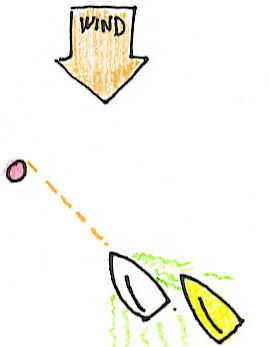
The green marks show what happens to the wind around a boat. There is not only a turbulence to leeward, but also to windward. The turbulence is much bigger to leeward, and that's why we stay out of other boats' wind shadow. However, the turbulence can be just as devastating to windward. In this case, Towney was already pinching to ensure he could get around the mark, so he couldn't come up any further. He couldn't come down to go below us; he had to make the mark. So we stuck it to him, and it worked this time. (It's not often you get to do something like this to Towney!)
As an aside, there are times when we will be on starboard tack, and a port-tacked boat will be converging on us. There may be times when we duck the port tacker and tell them to cross. This is because it is better to have them cross then to lee-bow us. This can be especially if the port tacker is not a seasoned sailor, since they may think they can't cross and inadvertently lee-bow us.
Once we got around that mark, we were in fat city. Scott flew an excellent downwind leg, and even coming into the harbor we had good speed and carried the victory!
Way to go crew. Nice race!
--Tim
Subscribe to:
Posts (Atom)