Tuesday, September 16, 2008

Oct. Racing Column for the Alberg 30 Mainsheet

Ahh, fall racing in Annapolis.  If only the heat would subside...then it would feel like fall!

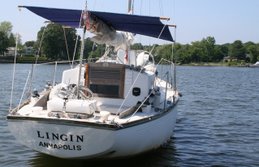
We had very nice race to and back from Oxford this September.  Four Albergs made it to the starting line: Argo, LinGin, Second-2-Nun and Windswept.  While the weatherman predicted 5-10 knots out of the north on Saturday, but the weather gods had their own plans: we saw 0 to 5 out of every direction except the north.  Go figure.

There were 185 boats across all classes entered in the race down and the Albergs were scheduled to start first.  Starts in such conditions can pose some challenges: 

  1. You can't watch the other classes start to help you develop your starting strategy.
  2. You don't get much time to prepare for the start; it's usually a 5 minutes and BANG! you're off.
  3. It's quite possible that you'll be trying to start with dozens (or in this case a just shy of 200) other boats encroaching on the line.

In this case, it was pretty rough.  The wind was light at the start off of Tolly Point at R2, but in my opinion, a very raceable wind.  The race committee felt otherwise and with about a minute to go before our start, postponed and move the line a mile south just past Thomas Point Light.  I suppose they felt there might be a little bit of breeze coming out of the South River.

Once back in the starting sequence, the wind really started to die.  It was at this point we became nervous.  There were boats everywhere crowding around the line and killing the very light westerly breeze.  To top it off we had a ripping current dragging us south.  With a minute left before the start, Argo was clearly in the best position: slightly north of the line with a little bit of speed.  We aboard LinGin were in a dangerous spot: barely north of the line and moving ever so slightly to the north.  Second-2-Nun and Windswept were in an agonizing position: both were stuck south of the line, battling the current and clearly destine to be over early.

I was so worried that we would be swept over the line early that at 1 minute that I scrambled frantically and grabbed my little anchor out of the starboard locker.  Dang!  It didn't have a line attached to it.  "Why had I removed that?", I wondered.  I grabbed a line, then looked at the depth gauge: 26'.  The line was too short.  Dang!  I found a good, long line and tied it to the anchor.  I quickly heaved it overboard a couple feet and noticed that if we dropped the anchor here, we'd have to drag back a couple of boat lengths before it would hook.  Then we'd be over early.  Dang!  By this time there was nothing to do other than wait for the starting gun.  

BANG!  I listened intensely to the VHF.  Would we be called over early?!  Nothing.  This was odd; I knew at least two boats were over early and they should be called.  Inspecting the radio, I quickly realized the channel had somehow been switched from 77 to 78.  Dang!  My crew assured me we weren't over early, but I hate going on a 30 mile race not knowing for sure  whether I was over early.  Oh well.

Argo had a nice start and quickly set their spinnaker to take the lead.  We both set about the task of getting to the deepest water we could to take advantage of the favorable current, while trying to staying in any pressure we could find.  Windswept and Second-2-Nun battled their way toward the line.  The race committee postponed again and moved the line further south for the remainder of the fleet.

After an hour or two of very light conditions, we passed Argo by catching some pressure that they missed.  We then plodded down the bay in the brutal heat and sun.  By the time we rounded the first mark we started to wonder if we would finish by the nine hour time limit.  Thankfully we caught word on the radio that the race committee shortened the course and was finishing the race at the second mark at the entrance of the Choptank River.  There was hope.

Enduring another becalming and dealing with our second "spin-out" due to waves and no wind, we caught site of Second-2-Nun and Windswept.  They had caught up considerably and with the light winds, anything was now possible.  Apparently our wind in the front of the pack had died before theirs did, allowing them to close the gap.  The racing was getting more intense!

In the end the wind picked up just in time for our finish: we finished with 13 minutes left on the clock.  Windswept crept up and took second 9 minutes later and in a photo finish, Second-2-Nun beat Argo by 4 one hundredths of a second!  I love racing these old boats.  They're so evenly matched!  Nine hours of racing and still a remarkably close finish.


Division: Alberg 30 (5 boats)

PosSailBoatSkipperRatingFinish
Order
Finish
Time
AdjustmentsPts
1  244LinGinWilliams, TimothyAlberg 30117:46:39.01.0
2  562WindsweptHelms, LannyAlberg 30217:55:28.02.0
3  484Second-2-NunGamber, HarryAlberg 30317:59:23.03.0
4  247ArgoWilliams, T.C.Alberg 30417:59:27.04.0
DNF  152AndanteCole, AndrewAlberg 30DNFNo TimeDNF6.0

After an enjoyable night in Oxford, we were treated to a beautiful 10 to 15 knot breeze out of the south, making for a relatively quick trip home.  The start was upwind and we were able to time our start at the pin just the way we had hoped: with speed and clear air.  Argo started right below us, but unable to push us above the pin.  Windswept and Second-2-Nun crossed the line slightly below Argo with good speed.

Making our way upwind to the first mark, our thoughts mainly centered on covering the fleet.  We need to put in a hitch to avoid shallow water, and did so about halfway up the leg.  The others followed.  We went a bit further than we'd planned on before making our next tack, but we kept every one to leeward of us as we made our tack and headed toward the mark.  We kept close eye on the Cal 25s that had started before us and we pleased to see that the wind seemed to be lifted ahead, but not so much that we'd overstand the mark.  We gained good separation by the first mark, rounding ahead of Argo, with Windswept and Second-2-Nun following in order.

The next two legs were reaches that basically cemented the positions; no one had a significant boat speed advantage to change the places.  Rounding the penultimate mark, it was an 8 mile spinnaker run to the finish.  The breeze made a very hot day bearable, but dead downwind it was still very hot.  We finished first followed by Argo, Windswept and Second-2-Nun.

Official Results from the Hammond Memorial Race (the race back from Oxford) were not available at the time of publication.

It's quite possible that you're reading this before October 18th.  If you are, please consider coming out to race in the Canadian Friendship Races, or to attend one of the evening events.  Everything is taking place out of the Potapskut Sailing Association's (PSA) club up in Pasadena and we'd love to see you out there!

See you on the water!


Tim Williams

Sunday, August 17, 2008

Sept. Racing Column for the Alberg 30 Mainsheet

This month is the real start of the Alberg 30 fall racing season. We have two races this month: Oxford and Queenstown.

Oxford is my favorite race on our schedule. You never know what kind of ride you'll experience on the way down, but it's usually exciting. (One year I snapped my tiller in the middle of the race...ask me about it sometime.) Once you're there, you can wander the small streets of the town and find some good grub to eat with your crew.

You'll probably run into other A30 racers where ever you end up. On LinGin we somehow always pick the restaurant that Second-2-Nun does. It's always a pleasure to trade some good natured jabs with Harry his crew!

The next morning, I'll head out early for a jog through town and to grab some sandwiches for the crew to eat on the race home. The Albergs are usually a late start so we don't have to head out to the line as early as the other boats. It's really neat to walk along the waterside park there, listening to the starting gun go off and watching the boats head down the Tred Avon River as the day begins to unfold.

The race back from Oxford ends about half way up the bay, which has it benefits and detractors. I'm not sure I like it ending there, but I can tell you that the racing conditions in the rivers versus on the bay are almost always very different.

Queenstown is a great event for everyone, but especially for those boats on the Magothy River since our start takes place at Baltimore Light. It's not a very long race; we shoot straight across the bay, into the Chester River and up to Queenstown. I think that's part of the reason families enjoy this race.

Once there, we raft up and the race committee creates a floating party by tying two work boats together and providing refreshments. Much merriment is made and many sea stories told and just about when you think the work boats are going to sink because of all the people on them, the party breaks up for everyone to cook their dinner and settle in for the evening.

The next morning it's a race back the way we came. With good conditions we're back at Baltimore Light by two in the afternoon with our sails full and a spirits lifted. Nothing does that like a good weekend of sailing!

Of note, if you've never seen someone actually have the grounding that wins them the Keel Wheels Award, Queenstown is not a bad place to try to catch it. If you're good at FOLLOWING the boat ahead VERY SLOWLY, you'll probably do fine getting in and out of the harbor. If you're not, well, there just may be half a roller skate nailed to a plaque waiting for your name to be inscribed on it.

Don't forget to make plans for the Canadian Friendship Races NOW! They're October 18th and 19th this year and we'll be sailing out of the Potapskut Sailing Association's (PSA) club up in Pasadena.

One of the things we're excited about is that each day of racing will start and finish out of PSA. This means everyone will be together each day and we're hoping that will facilitate the sharing of stories and allow everyone to get to know our Canadian guests all the better. Don't miss all the parties that Mike Meinhold is putting together for us, too!

If you have any questions or would like to discuss bringing your boat up early, please contact me or Larry Morris, the race coordinator.

See you on the water!

Tim Williams

August Column for the Alberg 30 Mainsheet

This past month a couple of our local racers headed to the great white north to take on our Great Lakes sister organization in a friendly set of races. See the article in this edition of the Mainsheet for all the details. I'll urge you to add this to your list of "things to do in 2009" right now. It's a fun time and an excellent way to make good friends that you probably wouldn't otherwise meet.

Since the June racing is covered in the article, I figured I'd take a moment to write a bit on something I've learned the hard way about racing over the years: how important it is to split up the task of steering and the role of tactician.

Many of us as boat owners find we like being in control. We wanted a boat. We saved up our hard earned cash and bought the boat. We pay (and do) the maintenance on the boat. We even provide the food and drinks on the races! If you're anything like me, one of the things you like about racing your Alberg is the fact that you are in charge!

When it comes to running the boat, trying to control everything is a recipe for trouble. Here's one of the main reasons why: I've come to the conclusion that you really can't race your best when you're trying to steer the boat and play tactician at the same time. Believe me, I've tried and I can't make it work. My teenage daughter can talk on the computer to seven people at once while watching TV. I can walk and chew gum with aplomb. I cannot steer and call tactics at the same time.

When I moved to Annapolis five years ago, I needed a crew. I grew up racing with my family, but when I arrived in Annapolis my brothers all lived on the other side of DC and Wednesday night racing was not in the cards due to the commute and the fact that they had young kids at home. Thankfully, I found a great group of guys for crew, but I had one problem. None of them had done any racing.

I found myself trying to teach the mechanics of the boat, steer and call tactics for that first year. It was fun but frustrating. The next year, I found they really had the mechanics down, but no one had really stepped up to the plate on the tactics side of things. Maybe I hadn't been teaching them how to do that.

We try to do a post-race debrief after every race and the ride back to Whitehall Creek from the Spa Creek on Wednesday night after racing is a great time to have that talk. We discuss things we did well and things we did poorly. We also talked about anything anyone didn't understand.

Too many times that second year, I'd realize that I'd made terrible calls as tactician because I had my head down in the boat. I'd call for a tack without realizing that I was heading to the wrong (unfavored) side of the course, or tack into a pack of boats that would soon roll us. Once I realized the error of my ways, I really pushed my crew to learn the role of tactician.

Becoming a tactician is something that takes time. You have to develop a sense about racing, the rules and how to make the boat go. However, I find that most people will not do the hard work of learning it unless challenged, encouraged and rewarded. Start a young tactician off by having him or her reading some of Dave Perry's books and the North U. books about tactics. A subscription to Sailing Smarts, a racing focused newsletter, is an excellent tool. Be on the lookout for good articles in Sailing World. Join the racers at a happy hour or a post-race party and ask lots of questions. Don't be afraid to draw some pictures! They can be invaluable.

Today, I have a couple of members of my crew that I can really trust to take on the role of tactician. It's great having someone with which to discuss strategy. If you can, I'd recommend you choose to drive or call tactics--not both--and watch your performance improve.

I like driving and so that's where I keep my focus. (I think it's a control issue.)

The race to Oxford is our next race on September 13th. Make your plans now and get your crew together! It's going to be a wonderful race.

Until then, please come out and join us on a Wednesday night race on the Severn or the Magothy. Just drop me a note and I'll help you find a spot.

See you on the water!

Tim Williams
Wednesday, July 16, 2008

July Racing Column for the A30 Main Sheet

This past month a couple of our local racers headed to the great white north to take on our Great Lakes sister organization in a friendly set of races. See the article in this edition of the Mainsheet for all the details. I'll urge you to add this to your list of "things to do in 2009" right now. It's a fun time and an excellent way to make good friends that you probably wouldn't otherwise meet.

Since the June racing is covered in the article, I figured I'd take a moment to write a bit on something I've learned the hard way about racing over the years: how important it is to split up the task of steering and the role of tactician.

Many of us as boat owners find we like being in control. We wanted a boat. We saved up our hard earned cash and bought the boat. We pay (and do) the maintenance on the boat. We even provide the food and drinks on the races! If you're anything like me, one of the things you like about racing your Alberg is the fact that you are in charge!

When it comes to running the boat, trying to control everything is a recipe for trouble. Here's one of the main reasons why: I've come to the conclusion that you really can't race your best when you're trying to steer the boat and play tactician at the same time. Believe me, I've tried and I can't make it work. My teenage daughter can talk on the computer to seven people at once while watching TV. I can walk and chew gum with aplomb. I cannot steer and call tactics at the same time.

When I moved to Annapolis five years ago, I needed a crew. I grew up racing with my family, but when I arrived in Annapolis my brothers all lived on the other side of DC and Wednesday night racing was not in the cards due to the commute and the fact that they had young kids at home. Thankfully, I found a great group of guys for crew, but I had one problem. None of them had done any racing.

I found myself trying to teach the mechanics of the boat, steer and call tactics for that first year. It was fun but frustrating. The next year, I found they really had the mechanics down, but no one had really stepped up to the plate on the tactics side of things. Maybe I hadn't been teaching them how to do that.

We try to do a post-race debrief after every race and the ride back to Whitehall Creek from the Spa Creek on Wednesday night after racing is a great time to have that talk. We discuss things we did well and things we did poorly. We also talked about anything anyone didn't understand.

Too many times that second year, I'd realize that I'd made terrible calls as tactician because I had my head down in the boat. I'd call for a tack without realizing that I was heading to the wrong (unfavored) side of the course, or tack into a pack of boats that would soon roll us. Once I realized the error of my ways, I really pushed my crew to learn the role of tactician.

Becoming a tactician is something that takes time. You have to develop a sense about racing, the rules and how to make the boat go. However, I find that most people will not do the hard work of learning it unless challenged, encouraged and rewarded. Start a young tactician off by having him or her reading some of Dave Perry's books and the North U. books about tactics. A subscription to Sailing Smarts, a racing focused newsletter, is an excellent tool. Be on the lookout for good articles in Sailing World. Join the racers at a happy hour or a post-race party and ask lots of questions. Don't be afraid to draw some pictures! They can be invaluable.

Today, I have a couple of members of my crew that I can really trust to take on the role of tactician. It's great having someone with which to discuss strategy. If you can, I'd recommend you choose to drive or call tactics--not both--and watch your performance improve.

I like driving and so that's where I keep my focus. (I think it's a control issue.)

The race to Oxford is our next race on September 13th. Make your plans now and get your crew together! It's going to be a wonderful race.

Until then, please come out and join us on a Wednesday night race on the Severn or the Magothy. Just drop me a note and I'll help you find a spot.

See you on the water!

Tim Williams

Saturday, May 17, 2008

June 2008 Racing Column for the Mainsheet

The annual NOOD (National Offshore One-Design) regatta was held in Annapolis over the last weekend in April this year. The Albergs had a nice turn out with seven boats making an appearance on the course. Many years, the wind lightens up and we loose a day of racing. Not so this time: our fleet completed 8 races over three days. By Sunday night I feel like I need to take two days off before going back to work. I was exhausted!

The great thing about having so many races is that it gives you the chance to make up for mistakes. If you really mess up a spinnaker douse in one race, you're not out for the series. It also gives you enough time on the course that you're almost always exposed to a variety of conditions. That was the case in this regatta. The first two days of the NOOD were very similar: light to medium air (5-10 kts.) out of the north with a powerful current developing throughout the day. The third day, however, the wind really picked up (15-20 kts.) and made for quite a different scene. Solid crew work became extremely important, and if you didn't change the way your boat was set up from the day before, you were going to be slow.

There are two things I'll never forget about this regatta. The first is watching Lanny Helms and his crew aboard Windswept drive away from the fleet the last day of racing. It was incredible to watch that boat go. He had two great starts that second day and took off, never to be caught. I pressed him at the award ceremony as to how he had her set up to make her go so fast, but it seemed difficult for him to talk he was smiling so much. Way to go Lanny!

The second thing I'll never forget is Brian Palmer crewing for me and doing foredeck. Brian is not my regular foredeck; I was supposed to have my cousin on board Sunday doing foredeck and he's been doing that for over 20 years. Brian, however, is exactly the kind of crew every skipper loves: he'll do whatever he's asked--no questions asked! Brian does foredeck for us about twice per year, usually because someone had to bail at the last minute. (Which is what happened in this case.) He's a trooper for trying to re-learn the whole process on the way out to the race course.

With 15-20 kts. blowing, we weren't sure we wanted to fly the chute, but if you're not in the lead it's hard not to at least give it a try, so we did. One thing you should know is that I do my boat maintenance by crisis; if she's sinking, or something is broken that will cost us in a race, then it gets fixed. Otherwise, find a work-around! Apparently one area that I need to improve is the spinnaker halyard shackle. The pin is bent and if you don't PRESS it in--even thought it may be latched--it will pop lose. Brian had unfortunately not received this memo and I didn't communicate it in my review of the process.

The call for the spinnaker to go up on the second leg of the first race was made, and my other crew, Ray Meyer, gave it all he had. It was his first weekend on LinGin, so maybe he thought our spinnaker was ULTRA light weight, or maybe it all happened just so fast... Regardless of why or how, within a second or two we had the spinnaker halyard at the top of the mast. Not just part of the way, but ALL the way.

We finished up that race and knew that we would only have about 15 minutes between races. (As Race Committee, you have to hustle to get in 8 races in three days.) The seas were big when we headed out and had only grown throughout the morning. Thankfully Brian has done some rock climbing in his past, because he agreed to hop in the bosun's chair and be pulled up the mast to retrieve the halyard. You'll have to ask him yourself about how the trip was, but I know that most of the fleet watched the feat closely--it was exciting! We had a lot of questions at the party after the race about our Spiderman. Let's just say that the bumps you and I feel at deck level are nothing compared to what one feels at the top of the mast!

At the end of the racing LinGin carried the day, but just narrowly. T.C. Williams on Argo had a great third day and really gave us a scare, coming in a close second. Jonathan Adams teamed up with Larry Morris to co-skipper Laughing Gull for this regatta and they made a great team. They were extremely consistent throughout the regatta and came in third. Lanny was not far behind Jonathan and Larry.

I am really pleased with the competitiveness of all the boats in our fleet. Albergs are a great boat to race! Please come join us sometime.

Two final thoughts:
  1. Have you considered joining us for the races in Canada this June? It's June 14-15 in Toronto and I can promise that you'll have a great time and make new friends. Please contact me if you're even just thinking about it.
  2. Albergs are racing in Wednesday race series on both the Severn and the Magothy rivers. If you've been thinking about getting your boat out, but have some questions, please drop me a line. I'm happy to help get you out on the water.
I look forward to seeing you all on the water. Tim Williams

Thursday, May 08, 2008

LinGin Wins First WNR

Crew: Scott, Chris, Xa, Nicole (friend of Chris) and Tim
Wind: 10-15kts out of the south

We had a beautiful night of sailing this week. It was great to see Brian Palmer out skippering L'Esprit in her first WNR!

We had a good solid start and quickly jumped ahead of Argo by a couple boat lengths. Our course took us almost out of R2 at the mouth of the Severn on a fairly steady reach. At one point the wind lightened, and Argo started to catch up. We eased the backstay and the jib halyard. We also eased the outhaul and fattened up the main. We went to 8 to 10" off the spreader for the jib and lo and behold, we started to move on Argo. We shifted gears! Excellent!

We took a hitch before rounding the windward mark to get out of a lot of spinnakers. We just barely crossed L'Esprit on port. (Whew!) I think it's clear that Brian has plenty of speed with that new bottom and those new sails. (Not to mention the crack crew--his parents!)

After that it we had a great spin set with Scott on the foredeck. We led the fleet in until we rounded the green can at the entrance to the harbor. We got caught behind and below a Catalina as we rounded. He came up and slowed down more quickly that we did. We were too close to shoot above him and had to plow below him. That killed our speed and Argo charged by us to windward.

We went to the docks and tacked and lucky for us, Argo had to take two tacks where they only wanted to take one. This gave us the advantage we needed as the winds were light and tacking was painfully slow. We crossed the finish line a short bit before them.

L'Esprit came in fourth (last) behind Argo and Second-2-Nun (Harry), but she didn't fly her chute, so I think it could have been quite a different finish had the been able to do so.

We had a great time and are looking forward to next week.

--Tim

Thursday, May 01, 2008

LinGin Wins the NOOD


The 10th annual Sailing World NOOD Regatta took place this last weekend and LinGin’s crew had great success.

Day 1 & 2

Crew: Ray Meyer (“the new guy”), Glen, Scott, Mark (1st day), Brian (2nd day), David (2nd day) and Tim
Conditions: 5-10 kts. with little chop
Location: Approx. 1 mile south of the Hacketts Point can

The first two days of the NOOD were very similar: medium to light air with current building throughout the day. We had pretty good starts, working to get a spot on the line with speed in clear air. Early in the day going right into the deep water was an option had it been desired, but after the first race each day the current was such that the key to success was to go left to get in the shallow water and out of the current.

LinGin was pretty dialed-in for these conditions. We moved the jib cars up to the “I” hole on Mark’s suggestion. The idea was that the foot was extremely flat in our normal position, the “G” hole. It seemed to produce good results; we had good speed and could point well. Our backstay was on 4 which is moderately tight. Overall we sailed her with the sails pretty flat.

The second race of the first day we lost a place to Argo during our windward mark rounding. The current was coming on strong and we were coming into the mark on port. Argo came in on starboard. As we were closer to the mark, we were able to tack inside of Argo and feel we had a good chance of making the rounding. Since they were further out when they made their tack to the mark, they had to overstand a bit be sure the current didn’t push them out of reach of the mark.

Unfortunately for us, the wind was lightening and shortly after a relatively slow tack, we were rolled by a Cal and Argo, causing us to stall and drift toward the mark. There was a short moment when we thought we might hit the mark, but I was able spin the boat around back to port tack and we had to regain speed, overstand the mark and then tack again. Needless to say, Argo was quite a bit ahead by that time.

Had I to do it over again, I would have tried to swallow my pride and realize that ducking Argo and being 2 boat lengths behind was a far better position than 20 boat lengths behind. Ah…next time…hopefully.

We did end up needing a repair. The spinnaker pole track was bent significantly and I had to race down to Fawcett to get a replacement. Hopefully Scott will take it easy on this next one! ;-)

A neat side note is that Bill Wager, a sports writer for the Capital, picked up on our success and interviewed me after the second race. We appeared in an article the next day. Pretty cool!

Results
Day 1: 1, 2, 1
Day 2: 1, 1, 1

Day 3

Crew: Ray Meyer (“a regular”), Brian and Tim
Conditions: 15-20 kts. with chop
Location: Approx. 1 mile south of the Hacketts Point can

Day three was a tough one for LinGin from the time we left the dock. A missed e-mail from my cousin, Chris, left us with only three on the crew and Brian valiantly filling in on foredeck—a position he doesn’t get much practice in.

After some discussion about No. 1 or No. 2 jib and main reefing we settled on a reefed main with the No. 1. After shaking the reef on the first downwind leg, we never put it back in. I was glad that we didn’t go with the No. 2.

Our first start was good; we were on the line with speed, but we were immediately rolled by Lanny Helms (#562, Windswept) and bunch of other boats. Uh oh. We were definitely not set up properly for the conditions. We spent the rest of the day changing settings to try to find our groove.

The first spinnaker set was a bit iffy with a number of configuration changes made before setting the chute about 2/3 the way down the leg. The second time around the snap shackle on the halyard came undone just as Ray went to hoist the sail. The result: the spinnaker halyard at the top of the mast and Brian scrambling to switch to the trusty whisker pole wing-in-wing configuration.

In between the first and second race, we took Brian up the mast. Now you have to keep in mind it’s blowing between 15 and 20 knots and there are significant seas. At boat level, we feel the waves, but 40 feet up the mast you REALLY feel the waves. Half way up Brian got bounced around a bit, but his rock climbing experienced paid off and he made it all the way to the top to retrieve the spin halyard. He definitely earned his sandwich this race! My hat is off to his willingness to make the climb—I never even had to ask.

The second race we suffered more speed and pointing problems. In the end we chased Argo up the last windward leg and tested some ideas out. Here are my thoughts:

  • Don’t be afraid to significantly bear off when there are seas out there. Towney did this once to us—I thought he was crazy to bear off 20 degrees rounding the leeward mark to go upwind. You’d think after being spanked by him at the top of that course that I would have learned my lesson. Next time, I will suck it up and bear off so I can plow LinGin through those waves. We went 8-10” off the spreader with the jib and seemed to be making ground on Argo on that last leg. (Too little too late to catch him, though.)

  • Lanny was smokin’ fast. Speaking with him after the race he talked about how loose his rig is. I think this may be key. Fast and fast in the slop. Next time I’ll try really loosening up the back stay and easing the jib halyard. We probably should have eased the outhaul too.

Last but not least, I can’t say enough good stuff about Ray. He’s a former Cal racer that now owns an Alberg with his wife. They are cruisers right now, but he’s a really good racer and I’m hoping that we can infect him with the racing bug. He’s planning to join us on Wednesdays this summer and I’m looking forward to it.

Results
Day 3: 4, 3

I hope I see you all out on the water this summer. Come join us!

--Tim


p.s. Thanks to Brian Palmer for all the great photos!


Monday, September 24, 2007

LinGin Places Second on the Race Back from Queenstown

Here's a summary of the race that I provided Towney:

Towney,

The race back was fun, but disappointing. We won the start and lead the race until about 15 min. from the finish when CB jumped ahead of us.

The wind had been 15-20kts out of the N for the morning, and our choice of our No 2 worked well. However, when we rounded the red nun to head back to Baltimore Light, the wind was too far forward for our chute. We held pretty well with both TC and CB (who were 10-15 boat lengths behind) for 4.5 out of the 6 miles. TC had held high with the hopes of popping his chute and charging ahead to the line. CB, on the other hand, took the rhumb line with the idea of holding the jib all the way in. We took something of the middle to minimize our risk, but the wind began to die and we knew we would get rolled if we didn't do something. A headsail change was out of the question as it would take too long. We headed up for a bit and put up our old, narrow spinnaker. (It does better on a close reach than our more full new one.) We were first with the spinnaker up and seemed to be doing quite well. However, as the wind went from 10+kts to less than 2, it swung about 150 degrees aft. Ugh. Between CB having a better angle and his having his big shouldered chute up, we had little hope. It was big seas and no wind, which, by the way, is my least favorite kind of sailing. We held off TC quite well, but couldn't manage CB.

I feel good, because we had a great race and I feel we really covered our bases and did the best we could in those conditions. Had the wind held, or gone forward, I think we would have won.

It was a great weekend to be on the bay!

--Tim

Division: ALBERG 30 (5 boats) (top)

Pos Sail Boat Skipper Rating Finish
Order
Finish
Time
Penalty Pts
1 57 INFINITY Charles Currier
1 13:11:04.0
1.0
2 244 LIN GIN Tim Williams
2 13:12:35.0
2.0
3 247 ARGO T C Williams
3 13:19:49.0
3.0
4 501 SOLSTICE Larry Morris
4 13:41:12.0
4.0
DNC 197 LAUGHING GULL Jonathan Adams
DNC No Time DNC 6.0


Start Date/Time = Sunday, September 23, 2007 10:10:00.0, Length (nm) = 13.60

LinGin Wins Race to Queenstown

With a family-based crew (Andréa, Darcy and David) along with the capable Brian Palmer, LinGin had a fine race to Queenstown, taking the gun at the finish. (It was a real gun. Imagine!)

The wind was a steady 10 kts. out of the south, so the course was pretty much a straight shot across the bay and up the river. Like many years before, there were no tacking legs in the course. Good for family racing, I think.

The start was a bit hairy. T.C. Williams (Argo) was barging and his spinnaker hit our spreader. Unfortunately, Larry Morris was coming up underneath us and with T.C. in the way, we couldn't get out of Larry's way and he very nearly hit us (there was some good fending off that went on). T.C. did his turns right after the start and we did ours too. Larry did turns for not giving us room to maneuver (he just came right up and hit us, even though we had no where to go).

After a fair amount of thought and discussion, we're not sure we should have done turns as we think we could have kept clear if T.C. had not been barging. Oh well, it turned out it didn't matter.

C.B. (Infinity) started mid-line (and a bit late) so he wasn't involved in the starting melee. We were lucky to get through our turns quickly and get after C.B. On the second leg, we were able to fetch the next mark without a tack, but C.B. got a bad shift or bad air and had to tack to make the mark. He lost a couple places in that situation and we successfully held T.C. off for the rest of the race into the finish line.

One item of note is that we did not run aground in Queenstown! I'm pretty sure that in some 20 years of doing this race that this quite possibly is the first time I can say that.

--Tim


Division: ALBERG 30 (5 boats) (top)

Pos Sail Boat Skipper Rating Finish
Order
Finish
Time
Penalty Pts
1 244 LIN GIN Tim Williams 1 12:39:45.0
1.0
2 247 ARGO T C Williams 2 12:41:45.0
2.0
3 501 SOLSTICE Larry Morris 3 12:44:10.0
3.0
4 57 INFINITY Charles Currier 4 12:46:02.0
4.0
5 197 LAUGHING GULL Jonathan Adams 5 12:48:30.0
5.0
Notes

Start Date/Time = Saturday, September 22, 2007 10:10:10.0, Length (nm) = 13.60

Monday, September 17, 2007

Hammond Memorial Race - Alberg Results

1. Tim Williams
2. Lanny Helms
3. C.B. Currier
4. Harry Gamber
5. T.C. Williams
6. Jonathan Adams

53rd Annual Race to Oxford - Alberg 30 Results

Place

Sail No.

Boat

Skipper

Class

Time

1

244

LinGin

Williams,

Timothy

Alberg

31:59.0

2

57

Infinity

Currier,

Charles

Alberg

32:07.0

3

562

Windswept

Helms,

Lanny

Alberg

40:10.0

4

197

Laughing Gull

Adams,

Jonathan

Alberg

42:46.0

5

484

Second-2-Nun

Gamber,

Harry

Alberg

44:13.0

6

247

Argo

Williams,

T.C.

Alberg

47:42.0

Sunday, September 16, 2007

Hammond Memorial Race (Race Back From Oxford)

Having had such great success the day before, Scott and I were determined to do everything we could to repeat our performance. This time, however, we decided we'd start in the lead and let everyone try to catch us. At least that was our plan.

The wind was still out of the north on the way back, but this time it was closer to 8-10kts. We had a nice spinnaker start, especially for a crew of two. We were just a bit ahead of Infinity this time and Argo wasn't far behind either.

Next 10 miles were really a "foot race" in that there were almost no tacks, just a gybe or two round the marks. We actually flew the spinnaker the whole time--even when Infinity and Argo took theirs down. That really opened our lead to about 5 minutes at the final mark to the last leg.

That last leg, and last 8 miles of the race, were where things were really tough. It was a beat up the bay with 20+ degree shifts and tremendous changes in the wind velocity. One minute we'd look behind us and feel like heros. The next, we'd look back and our heart would be heavy. This was because of the huge shifts that were marching down the bay. They were bands of air and they would hit us and then travel down and hit our competition. Oftentimes we were in complete different air than everyone else.

Our strategy was really defense at this point. We selected Infinity, as they appeared closest, and tried to cover them.

In the end it worked out; no one ever really seemed to get close. We were very pleased to see Lanny Helms, Windswept, take second, and we were pretty sure there was another boat between him and Infinity.

The Whaley--Williams Dynamic Double-handing Duo. Fun stuff!!!

Race to Oxford

The forecast for the 53rd Annual Oxford race sounded pretty good: 15kts. out of the north. The crew situation was not. Sadly, I was unable to put together a full crew, but thankfully, I did get a solid commitment from my lead foredeckman, Scott Whaley. Singlehanding to Oxford was a no go, but double-handed…well, we'll give that a go.

Thursday night I gave Scott a call to see what he wanted for lunch and catch up on some race details, and was shocked to hear that Claire, the Whaley's 2 1/2 year-old Corgi, was extremely ill and at the vet hospital. As I believe most dog owners feel, the Whaleys felt like Claire was a part of their family. Scott said he'd get back to me about the racing.

Friday night, I was relieved to get an e-mail from Scott letting me know he would be coming to Oxford. I didn't find out until the next morning that Claire had to be put down late Friday. Although sad, Scott felt the race was would be a welcome distraction and Crystal's parents were coming to town to help with the kids anyway.

After some prep work, we headed for R2 to start the race early Saturday morning. It was blowing out of the north, but more like 20kts. with gusts up to 25. Scott, being the foredeckman that he is, wanted to pop the chute right away. I was a bit concerned about the gusts.

We started about 1/2 boat length behind Infinity, CB Currier's boat, and started chasing him down the bay. When he set his chute and started to pull away, there was no other choice but to raise ours and go.

We had a bit of trouble getting it up. We raised it, but I didn't put enough wraps on the which. So while I was pulling in the sheet, the halyard slipped and the sail came down. When I reached to grab the halyard, I didn't properly cleat that spinnaker sheet, so that ran free. Soon we had the spinnaker full up, but the sheet blowing in the wind.

It was quite a site to see Scott trying to grab the sheet when it went in the water. When a gust hit, the line acted as if it was electric fly and spinning around angrily. Scott finally grabbed it and got the sail under control.

A while later, thing got out of control. The wind was too puffy and shifty for us to handle by ourselves. When we dropped it, I rope-burned my hand something fierce and the sail got wildly out of control on the way down. I have this great image in my mind of Scott standing on the cabin top with his back on the main sail, completely covered in the blue and orange chute trying like mad to get it down below with all the wind and waves throwing us around.

After that it was whisker pole time, baby! We were about 7-10 boat lengths behind Infinity at this time and the other four boats behind us were quite a ways back. As we rounded a mark to go up the Choptank River, we had this sneaking suspicion that it would be difficult to get ahead of Infinity.

Approaching the Choptank Light we would be changing from a beam reach to close hauled to go to the finish line. There might even be need for a tack. Infinity decided to reef their main due to the high winds. We knew we have trouble with depowering against Infinity and decided that since there were only two of us onboard we would leave our main full.

Infinity's reef took place about 10 minutes from the mark according to our GPS. That gave us 10 minutes to narrow their lead and when we rounded, CB was yelling, "NO ROOM" at the mark. We were right on his tail.

Sure enough, Infinity started to move on us as soon as they came up to close hauled. At about 5 boat lengths ahead, Scott and I were of the opinion that we'd very likely come in 2nd. Rather than risk running aground, we made our penultimate tack and Infinity soon followed suit. When we tacked back we decided to do so because we are only two people and tacking is a pain that way! We decided that we didn't want to risk missing the line and have to make another set of tacks.

When we tacked, we couldn't believe our eyes! CB crossed right in front of us, kept going a bit then tacked back, but he had given us the lead in doing so. We didn't need to tack again, so we could sail a straight line in and while he was to windward, he was behind.

In a 4 1/2 hour race, we were in the lead for roughly 45 seconds. It was just the right 45 seconds.

As you might imagine, Scott and I we whooping and hollering when we got the gun. That was a lot of fun!

Wednesday, August 29, 2007

WNR Series 3 Race 5: No Wind

Unfortunately, tonight started out with light winds and developed into no wind. At approximately 1945 the Race Committee abandoned the race.

We had a poor start, as I was on the line early with a little speed. I didn't want to drop back behind the line only to loose speed and have to come back up underneath another boat, so I pushed the line. I was hoping others were too far back from the line and there would be enough space for me to squeeze in ahead of them. Wrong tactic. We were OCS (On Course Side) and had to duck back down to start again.

With the light winds we did well and spent most the race to the first mark trying to catch Towney. Near the end we hit a big power boat wake, spun out, and saw Argo truck ahead. Shortly thereafter, the race was called. Towney was the only Alberg to make it around the first mark.

I've been thinking that we should keep track of how we do in different wind conditions. My sense is that we have our most trouble keeping up (speed) with other A30s in mid to heavy wind. We seem to be pretty fast in light air. Perhaps we are either set up more for light air, or our sails are better suited for it. Something to think about.

Next week is the last WNR of the year. Let's hope we have some wind!

Thursday, August 16, 2007

David's Big Debut

Last night was breezy and we were shorthanded. Brian, Glen and I were joined by my son, David, for a very nice Wednesday Night Race. David has come out many times with us, but this was his first time where he really contributed. He did a couple of jib sheet releases on tacks and helped setup for a head sail change on the downwind leg by tying bowlines and a square knot. Great stuff!

The wind was 15 kts out of the S and we had the advantage of being in the Bay on our way over, so we rigged the No. 2. We also saw the Etchells start and noted that those boats that started on the north side of the Severn (the pin end of the line) had a solid lead.

Interestingly, as we watched subsequent starts, few boats took the pin end. We decided we would choose the pin and it paid off quite handsomely. We ran the line on starboard and had speed with clear air at the start.

The course was B2, which took us toward Hacketts Point and then back toward Tolly Point and in to the Severn. We lead the whole way, but had to choose between covering Argo or Skybird on the windward leg toward Tolly. We chose the right side of the course, covering Skybird, primarily because it was the long leg and also gave us the best options for being able to tack when we wanted. It paid off with us keeping ahead of Towney and making additional ground on Argo.

The rest of the race was a foot race into the finish and we crossed the line first with plenty of time to spare.

Key Thoughts
We've struggled in heavy air to keep LinGin going against the rest of the fleet. This race was one where it was questionable whether to go with the No. 1 or No. 2 jib--we were the only Alberg that flew the No. 2. I think LinGin, be it because of the cut of her main or whatever, prefers to go to the No. 2 in much lighter air than we generally think. I plan to select the No. 2 a bit earlier and see how we make out. It didn't seem to hurt us last night and I think it helped in the heavier spots. It's important to note that the seas were quite heavy too, so that didn't seem to slow the No. 2 down either.

Tuesday, August 14, 2007

August Alberg 30 Assoc. Racing Column

August Chesapeake Memories

August on the Chesapeake holds many memories for me. When I was in high school my grandfather, Bruce Rankin, had finally completed the training of his crew: my younger brothers and cousin, and me. We had all crewed for 5+ years and worked well together. We had a little bit of that "read each other's mind" thing going on, and it was fun. We did all the Annapolis Yacht Club Wednesday Night Races and at the beginning of each CBYRA racing season he'd give us the option of going after the High Point trophy.

One spring he asked us, "Would you rather race for High Point this year, or sail to Venezuela from Florida?" Being young, naive and having girlfriends, we foolishly chose High Point. Boy what I'd give to go back and choose the Caribbean adventure! Oh well. That's the problem with youth, right? It's wasted on the young.

When Grandpa went after High Point, he went after it. That meant that every race that counted toward High Point, we raced, and every race was raced until there was no more racing. Enter August on the Chesapeake. If March enters like a Lion and exits like a lamb, then perhaps August is best described as a 3-toed sloth, or the banana slug. I supposed if everyone is going to go on vacation in August, the wind has the right to as well.

That didn't matter to Grandpa and so there we'd be bobbing up and down in 0.02 knots of breeze in LinGin roasting like pigs on a spit in 98° heat and 100% humidity. If the time limit was 6 hours, we raced for 6:00:00 hours! We were committed. (Or at least Grandpa was, and because we couldn't swim far enough to make it home, so were we.) Looking back on int, I can't imagine that Grandpa enjoyed it too much either; we must have asked, threatened and whined to go swimming, climb the mast or start the engine thousands of time.

The youth in today's in the Alberg class doesn't have this problem. August is a "bye" month for the racers. Other fools may try to race in August, pounding through power boat chop in search of breeze, but our class smartly sticks to short Wednesday night races. Boy, things only get easier and easier for kids these days.

Are you itching to do some racing on an Alberg? Even in August? Well drop me a line and I'll get you out on a Wednesday--I promise. And if you're prepping for the fall racing scene--and we have lots of that--now is the time to get on those projects. Need help? Just let me know and I'll see what we can do.

Fall Alberg Races
September 15-16 Race to Oxford and back
September 22-23 Race to Queenstown and back
September 29-30 International Friendship Races

All of these are great, fun races. The Williams family is planning on racing Queenstown as a family this year. (With a little help from faithful crew.) Come join us for our only race north of the bridge! Call or e-mail me with any questions.

--Tim Williams

Thursday, August 02, 2007

WNR Series 3 Starts Off...and Loses Gas

We had a lovely evening last night with warm light breezes and lots of sun. The wind was out of the north, allowing us to set the chute shortly after the start. We beat Towney at the start, but with light, spotty breeze he made it around us. Thankfully, we were able to return the favor shortly thereafter. Argo found her own wind along the northern side of the Severn and rounded the mark in first, ahead of us by barely a boat length.

We passed Argo on the beat coming back in toward the city. We narrowly crossed Towney and almost hit one of the green cans, but still managed to round the red nun in first. Doing our best to fend off Towney and keeping a sharp eye on Argo, we set the spinnaker and made for the harbor. The Towney wind machine kicked in and he found his own air in front of the Academy.

In front of the Chart House, we were able to make a move to windward and pull up along side of Towney, but just as we were neck-and-neck, the time limit ran out. Bummer, because I think we had a good shot at taking them if we had another 10 minutes!

Great crew work everyone. Please welcome Wallace, Emily's friend that joined us last night.

Monday, May 21, 2007

June Mainsheet Racing Column

The 2007 racing season is off to a great start! We started the season with nine Albergs racing in the Annapolis National Offshore One-Design (NOOD) regatta. The NOOD is a three day regatta that regularly sees over 250 boats in attendance racing in three divisions. For the Albergs this is also our Maple Leaf Trophy regatta. The winner of the NOOD receives a half-model of his or her boat--arguably the nicest trophy given by the association.

The conditions this year were frustrating at times, but overall the competitors had a great time. Friday saw such light winds that the only race that was started had to be abandoned before the racers completed the first upwind leg. The saving grace was that the torrential downpour that was coming down during breakfast thankfully stopped just as the boats left for the race course.

Saturday started by looking like a carbon copy of Friday: no wind. However, a little before lunch, the wind came marching out of the Severn as if by some magical command. No sooner had the Albergs started did the wind die. Thankfully this time it came back up (although with something of a 100 degree direction change), and two races were completed.

The NOOD courses are always multiple laps around short windward—leeward courses. This produces fast races where good starts can make a big difference. Upwind strategy is important, taking current, wind pressure and oscillations into account all the way. Downwind, getting the spinnaker up quickly is vital to success, and depending on the wind pressure, deciding between a Rhumb line course and "tacking downwind" can be a tough decision one has to face. Since there are a lot of sail changes and transitions, crew work is action-packed--there's not much sitting on the rail in the NOOD. In fact, on my boat, our foredeckman wore a new watch that recorded his heart rate throughout the race. It was quite interesting to see his heart rate jump up at different points in the race--especially when he had to climb the mast to try to untangle a stuck spinnaker halyard!

Sunday brought with it steady wind that allowed two more races. I'll leave the sea stories to be told over beers at the next rendezvous by those who sailed in the boats.

It was tight racing with many boats in contention for silver throughout the weekend. T.C. Williams and his crew aboard Argo won the day through consistent speed and teamwork. Hats off to Argo! I've listed the overall results below.

Division: Alberg 30 (9 boats)

Pos

Sail

Boat

Skipper

1

2

3

4

Total
Points

1

247

Argo

T.C. Williams

2

1

2

2

7.00

2

57

Infinity

Charles Currier

3

5

1

1

10.00

3

550

Skybird

Rolph Townshend

5

2

3

4

14.00

4

244

LinGin

Tim Williams

1

3

10/DNF

3

17.00

5

562

Windswept

Lanny Helms

6

6

4

5

21.00

6

287

Calliope

John Bergquist

4

7

6

8

25.00

7

197

Laughing Gull

Jonathan Adams

7

4

7

7

25.00

8

567

Andante

Andrew Cole

9

8

5

9

31.00

9

484

Second-2-Nun

Harry Gamber

8

9

8

6

31.00

Upcoming Races

Depending on when you receive this letter, you may be able to join us for the Ted Osius Regatta on June 10th. This is an "around the bouys" race, meaning we don't end up at a destination at the end of the racing, so it lends itself to a nice simple day of racing. It's typically held right at the mouth of the Severn River and is a lot of fun. Ted's name is found on many of the Alberg trophies and I can remember being on LinGin chasing after his boat as a boy. It's a great regatta to support the memory of one of our own great sailors.

Beyond the Osius regatta, we Alberg racers take July and August off--and that's okay for me; there's rarely much wind and it is too hot!

--Tim Williams